Showing posts with label reef worlds. Show all posts

Tuesday, March 31, 2015

The Science Of Why You Should Spend Your Money On Experiences, Not Things

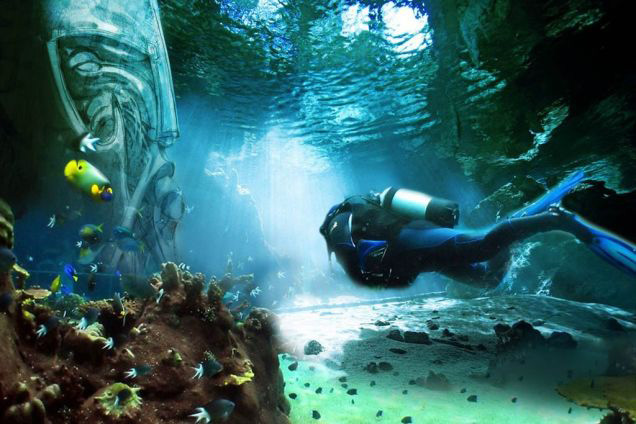
Art inspired resort reefs = resort vacation memories
Most people are in the pursuit of happiness.

There are economists who think happiness is the best indicator of the health of a society. We know that money can make you happier, though after your basic needs are met, it doesn't make you that much happier. But one of the biggest questions is how to allocate our money, which is (for most of us) a limited resource.

There's a very logical assumption that most people make when spending their money: that because a physical object will last longer, it will make us happier for a longer time than a one-off experience like a concert or vacation.

According to recent research, it turns out that assumption is completely wrong.

"One of the enemies of happiness is adaptation," says Dr. Thomas Gilovich, a psychology professor at Cornell University who has been studying the question of money and happiness for over two decades. "We buy things to make us happy, and we succeed. But only for a while. New things are exciting to us at first, but then we adapt to them."

So rather than buying the latest iPhone or a new BMW, Gilovich suggests you'll get more happiness spending money on experiences like going to art exhibits, doing outdoor activities, learning a new skill, or traveling.

Gilovich's findings are the synthesis of psychological studies conducted by him and others into the Easterlin paradox, which found that money buys happiness, but only up to a point. How adaptation affects happiness, for instance, was measured in a study that asked people to self-report their happiness with major material and experiential purchases. Initially, their happiness with those purchases was ranked about the same. But over time, people's satisfaction with the things they bought went down, whereas their satisfaction with experiences they spent money on went up.

It's counterintuitive that something like a physical object that you can keep for a long time doesn't keep you as happy as long as a once-and-done experience does. Ironically, the fact that a material thing is ever present works against it, making it easier to adapt to. It fades into the background and becomes part of the new normal. But while the happiness from material purchases diminishes over time, experiences become an ingrained part of our identity.

"Our experiences are a bigger part of ourselves than our material goods," says Gilovich. "You can really like your material stuff. You can even think that part of your identity is connected to those things, but nonetheless they remain separate from you. In contrast, your experiences really are part of you. We are the sum total of our experiences."

One study conducted by Gilovich even showed that if people have an experience they say negatively impacted their happiness, once they have the chance to talk about it, their assessment of that experience goes up. Gilovich attributes this to the fact that something that might have been stressful or scary in the past can become a funny story to tell at a party or be looked back on as an invaluable character-building experience.

Another reason is that shared experiences connect us more to other people than shared consumption. You're much more likely to feel connected to someone you took a vacation with in Bogotá than someone who also happens to have bought a 4K TV.

"We consume experiences directly with other people," says Gilovich. "And after they're gone, they're part of the stories that we tell to one another."

And even if someone wasn't with you when you had a particular experience, you're much more likely to bond over both having hiked the Appalachian Trail or seeing the same show than you are over both owning Fitbits.

You're also much less prone to negatively compare your own experiences to someone else's than you would with material purchases. One study conducted by researchers Ryan Howell and Graham Hill found that it's easier to feature-compare material goods (how many carats is your ring? how fast is your laptop's CPU?) than experiences. And since it's easier to compare, people do so.

"The tendency of keeping up with the Joneses tends to be more pronounced for material goods than for experiential purchases," says Gilovich. "It certainly bothers us if we're on a vacation and see people staying in a better hotel or flying first class. But it doesn't produce as much envy as when we're outgunned on material goods."

Gilovich's research has implications for individuals who want to maximize their happiness return on their financial investments, for employers who want to have a happier workforce, and policy-makers who want to have a happy citizenry.

"By shifting the investments that societies make and the policies they pursue, they can steer large populations to the kinds of experiential pursuits that promote greater happiness," write Gilovich and his coauthor, Amit Kumar, in their recent article in the academic journal Experimental Social Psychology.

If society takes their research to heart, it should mean not only a shift in how individuals spend their discretionary income, but also place an emphasis on employers giving paid vacation and governments taking care of recreational spaces.

"As a society, shouldn't we be making experiences easier for people to have?" asks Gilovich.

Story here.

Wednesday, March 25, 2015

Florida's coral restoration to cost $250 million, when do you need the money by?

How to make money with the oceans and save it
A recent article in the LA Times caught our attention this week.

Apparently to save two species of coral in Florida the cost will be close to $250 million dollars - and take 400 years.

Cue the lamentations from the conservation crowd, "$250 million dollars!?"

Our response was more reasoned, "When do you need the money, oh, and when do you want to start?"

If one plugs in the typical way of doing coral conservation, $250 million dollars will take approximately 30 years to raise. The net effect will be diffused among 20-30 coral and oceans conservation groups and in the end little will be done with the exception of 70,000 lbs of shrimp being consumed at various fundraising events - that's a fair amount of shrimp.

Let's look at this same conservation fundraising issue through our lens.

1. Florida resort hotels account for the largest single use group of natural nearshore reef systems.

2. Less than 1% of Florida resort hotels have coral reef protection or mitigation programs.

3. The primary reason Florida resort hotels do not invest in their near shore reefs is "monetization." (They have not figured out a way to make money from their nearshore reefs directly.)

4. Art inspired artificial reefs not only rebuild habitat, they are also fully monetized from day one.

5. If 10% of Florida resort hotels adopted art inspired artificial reefs they would generate an estimated $470 million dollars in tourism revenues a year.

What could be done with $470 million dollars a year in additional tourism revenues?

A lot of coral restoration with a timeline of 10-20 years for project completion.

We need to start thinking differently in regards to oceans, conservation, and the way we create oceans solutions. Numbers like $250 million should spark ways of thinking that take us outside our comfort zones and into the places where innovation and inspiration give us answers.

Who's in?

Monday, March 23, 2015

LA Film and TV Designers, Dive Site Developers, Marine Biologists Building Artificial Reefs

Reef Worlds Underwater Reef
Los Angeles-based Reef Worlds, whose team includes film and television designers, dive-site developers, and marine biologists, are designing next generation sustainable reefs for tourism and the environment in a race to save inshore ocean habitat around the globe.
Environmental change has caused the loss of more than half the world’s reef building corals. Coral cover, a measure of the percentage of the seafloor covered by living coral, is now just 10-20 percent worldwide. The Caribbean, thought to be one of the more pristine global reef systems, has lost 80% of its coral cover in only the last 50 years.
CEO Patric Douglas notes that while scuba diving and snorkeling are a $3-billion-a-year business, most resort developments don’t offer much in the way of special underwater experiences. “Many five-star resorts have one-star waterfronts,” says Douglas. Reef Worlds estimates there are 500,000 square miles of resort oceanfront with limited appeal to adventurous tourists due to rampant habitat loss.
Worse yet, these zones have suffered decades of neglect as resort developers focused on land based amenities such as water parks and golf courses.
“Reef Worlds was established three years ago with the goal of working alongside resorts to create sustainable artificial reef systems that help reduce tourism pressures on natural reefs. Reef Worlds are fully monetized discrete mini-marine “protected areas” within the resort’s own footprint, allowing them to brand the signature underwater experiences of their guests while creating and fostering regional habitat,” says Douglas.
Reef Worlds have been promoting the economic and ecological benefits of what he calls “habitat tourism,” which would give resort owners a way to monetize the waters off their beaches, while relieving some of the pressure from aquatic tourists on natural underwater reef systems that are endangered or dying.
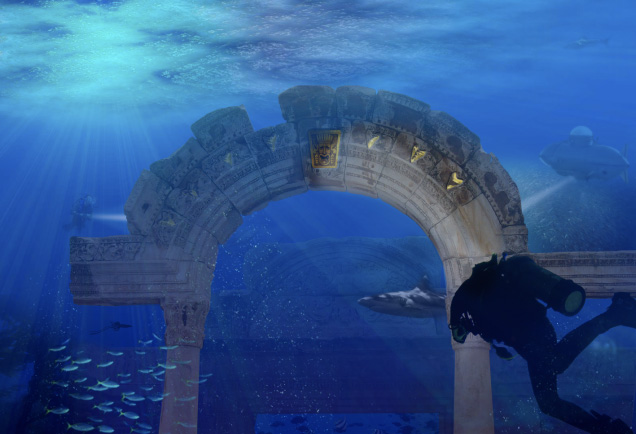
Reef-Worlds-Underwater-Arch
Artificial reefs have been around for decades. Most were created with everything from sunken battleships to old tires—and most, says Douglas, are boring. “Who wants to look at a concrete triangle?” he asks. Reef Worlds designs and creates “dynamic reefs” to attract sea life and tourism interest, making them places people actually want to explore, he says.
In Mexico, the company is developing an underwater art garden featuring 200 works of art that will take their cues from Mayan and Aztec iconography. Douglas calls this “Mayan Gods in 3D.”
Douglas says Reef Worlds will be able to bring in projects at 10-20% of the cost of a typical resort water theme park, which can run $70 million to build and $10 million a year to market and maintain. And unlike land based entertainment facilities Reef Worlds sites slowly transform over time into habitat for a wide range of wildlife and corals like a typical artificial reef.
Reef Worlds’ “Pearl of Dubai” project will be located in the waters around the World Islands development. Renderings suggest the park might be modeled after the mythic Lost City of Atlantis. Reef Worlds has five projects in varying stages of development in Dubai, Qatar, the Philippines, and Mexico.

Tuesday, March 10, 2015

Grazing fish can help save imperiled coral reefs

Parrotfish habitat 
With great interest our team read a recent press release by FIU researchers. The latest data suggests grazing fish species could dramatically help reef systems in the Caribbean. 
Habitat and no take zones that support grazing fish are a next logical step. Caribbean resort hotels can play a large role in the creation of these unique sites for grazing fish species.
MIAMIFeb. 24, 2015 /PRNewswire-USNewswire/ -- Grazing fish can help save coral reefs, but not all grazers are created equal, according to an FIU study published this month in Marine Ecology Progress Series.
A combination of factors is leading to the alarming loss of coral reefs worldwide, including ocean warming, disease and pollution. To make things worse, algae that can harm corals have also increased on many reefs. Fish and sea urchins that dine on the algae can help reefs recover but are unlikely to do the job alone according to FIU researchers Thomas Adam and Deron Burkepile.
The crystal clear tropical waters, which are home to coral reefs, are also a good environment for algae, which grow much faster than corals. If these algae are not quickly eaten by hungry herbivores they can smother adult corals and prevent young corals from finding a place to live.
The study, funded by the NOAA Coral Reef Conservation Program, examines impacts of herbivores on corals in the Caribbean, a region experiencing an increase in algae and significant loss of coral reefs.
In the Caribbean, algae began increasing in the 1980s, after spiny sea urchins — key grazers — were killed off by disease. Parrotfish eventually became the primary grazers on reefs in the region, but these herbivores are popular catches for fisheries.
"Clearly, parrotfish need to be managed for their impacts on reef ecosystems, and not just as a fishery resource," said Burkepile, abiological sciences professor who has spent most of his career studying imperiled coral reefs.
Parrotfish come in a number of varieties and play different roles on coral reefs. Some feed on microscopic turf algae, while others prefer larger seaweeds. Not all parrotfish live on coral reefs. The key for fisheries management, according to the researchers, is managing fish to keep them abundant in places where they can help corals.
"There are habitats where you find parrotfish, but the areas aren't particularly good for corals. It may make sense to allow people to fish in those locations," Burkepile said. "But there are also areas with no corals, such as seagrass beds and mangrove forests, that are important habitats for the babies of some parrotfish species.  That means that we have to protect those habitats too in order to ensure healthy populations of parrotfish on nearby coral reefs."
The findings contribute to a body of knowledge about the protection of coral reefs. While parrotfish are especially important for reefs, the researchers point out that a variety of herbivores are needed to help control algal growth. For example, surgeonfish eat algae that parrotfish do not like. More importantly, protecting herbivores is only one piece of a larger conservation puzzle.
"There are a lot of major concerns when it comes to coral reefs and protecting parrotfish is only one of them," Adam said. "Unfortunately, humans are doing a lot of things that have a negative impact on corals."
Media Contact: JoAnn C. Adkins
305-348-0398jadkins@fiu.edu
news.fiu.edu  
SOURCE Florida International University

Tuesday, March 3, 2015

Artificial Reef Tourism Paper - Fascinating!

Underwater LED art garden installation
Deploying artificial reefs on the seabed has become popular in diving management. This practice has been advocated as a means towards meeting both ecological concerns and recreational divers’ demands for diversification and themed experiences.

Nevertheless, the perceptions of the user community itself – the scuba divers – regarding the establishment of artificial reefs have received only limited attention in the literature.

Their views on critical issues concerning artificial reefs remain, as a result, fairly vague and speculative. The aim of the current paper is to bridge this gap in the literature by presenting the results of a study exploring divers’ attitudes and preferences with regards to the plan for a new artificial reef along the northern shore of the Red Sea in Eilat, Israel.

The findings indicate that the potential integration of this artificial reef was well perceived by the divers, regarding its contribution both to the diving experience and to the natural environment.

The divers also expressed their preference for large objects with a themed structure as artificial reefs, such as naval ships and airplanes, rather than more generic and amorphous forms, such as concrete blocks or pipes.

Overall, the study points toward the marketing potential of developing mass marine ecotourism through the deployment of artificial reefs at diving sites, as well as the prospect of promoting soft ecotourism in modified marine environments.

Complete paper here.

The Value of Saving Coral Reefs Now

Biodiversity – the range of species we share our planet with – is important, but can we put a value on it? And can we estimate the benefits and costs of conservation?

Professor Anil Markandya and two other economists (Luke Brander and Alistair McVittie) have written three new, scientific papers for my think tank, the Copenhagen Consensus.

They find that not only can we estimate the costs and benefits for some projects but also that conservation can be a great investment.

A target to preventing the loss of coral reefs will for each dollar spent deliver at least $24 of environmental benefits. Likewise, the researchers find that reducing future loss of forests by half would likely do about $10 of good for each dollar spent.

In Egypt, about 0.1% of the country is forested. The economists also find that increasing protected areas is likely to be a poor target, an important point as 11.2% of Egypt is already protected. This matters because the global community, spearheaded by the UN, is currently working to formulate a set of key targets, which will guide how resources are used from this year until 2030. These follow on from the Millennium Development Goals, an ambitious set of targets that directed hundreds of billions of development dollars since 2000.

The problem is that, right now, most interest groups understandably battle to include their favourite targets, but having more than a thousand potential targets leaves the world with no priorities. That is why the Copenhagen Consensus is helping by asking top economists to analyse what works and what we can afford. Of course, some of the obvious issues relate to adequate food, clean water and better schooling and healthcare.

But humans don’t live separately from the natural world. Rather, we rely on it for many different benefits or what experts call “ecosystem services”. For example, forests don’t just provide timber and firewood, but also provide flood protection, because they can soak up intense rainfalls – for instance, a big part of the reason Pakistan had such hugely damaging floods in 2010 was because large parts of its upper forests had been cut down.

Here, forests could have protected many of the poor that now saw their homes flooded or even their kids perish. Forests also provide residents near-by with beauty experiences, while drawing in tourism, generating more benefits. At the same time, growing forests take up carbon dioxide from the air and lock it away for decades or even centuries while producing oxygen. Forests also provide refuge for enormous numbers of bird, animal and plant species, especially found in tropical rainforests.

 All of these benefits can be valued.

Timber has a commercial price, so that is straightforward. Locking away carbon can be priced based on likely costs of avoided climate damage, and likewise flood protection value shows up as reduced future floods. There is also a value for recreation and tourism, but not all of this is paid for by the users. Moreover, preserving species clearly have a benefit, but typically not one we pay for. This is where putting a price on natural resources become more difficult, and economists have to fall back on surveys which ask people how much they are willing to pay to keep forests in place. That makes it more difficult to put a firm value on a hectare of forest, but the academics all agree that spending a dollar is likely to do more than a dollar worth of good. The most likely outcome of a series of cost-benefit analyses shows that setting the goal “reduce global forest loss by 50%” is likely to do about $5-$15 worth of social good for every dollar spent.

 The same kind of analysis suggests that preserving wetlands could be a good deal. The economists show that reducing global wetland loss by 50% will very likely do more good than its cost and most likely fall in the same range of about $10 back on each dollar.

More spectacular is the analysis for coral reefs, which act as both fishery hatcheries and fishing resources while storing abundant numbers of species. At the same time, coral reefs possess an amazing beauty, which both shows up in large tourism revenues but also in most individuals saying they are willing to pay a certain amount to make sure they continue to exist for our grandchildren. Coral reefs are found in 109 countries, but significant reef degradation has occurred in 93, according to the conservation organisation WWF.

The economists’ analyses illustrate that reducing global coral loss by 50% may cost about $3bn per year but the total benefits likely run to at least $72, or about $24 back for every dollar invested. However, economics also reveals poor targets: focusing to substantially increase protected areas is likely to cost so much – close to a trillion dollars – that it will generate less environmental benefit than the cost. Of course, as we look to the next 15 years, we have to spend most of our focus on the obvious wrongs with billions of people that are poor, lack food, water, health and education.

But these analyses suggest that carefully crafted, environmental targets should also be a part of this solution. Our job is to make sure that economic arguments are heard so we pick the smart targets but drop the poor ones, to make sure the next 15 years help the world and its inhabitants as much as possible.

Dr Bjørn Lomborg, an adjunct professor at the Copenhagen Business School, directs the Copenhagen Consensus Center, ranking the smartest solutions to the world’s biggest problems by cost-benefit. He is the author of The Skeptical Environmentalist and Cool It. His new book is How To Spend $75 Billion to Make the World a Better Place.

Monday, March 2, 2015

Artificial Reef Design Innovation For Tourism

New reef design and innovation
As you know we love artificial reef design.

For too long the concept of an artificial reef has been far too...artificial.

We live on a planet where nature provides us with an organic design library that stretches the imagination.

From sea shells to tiny plankton, our planet is a design wonderland waiting to be explored. And yet in the artificial reef space innovation, or the desire to try something new moves at a glacial pace.

This anti-design is a product of materials, project time length, budgets, and true innovation.

Naturally, when we see a breakout artificial reef design in use we get excited like last years effort in Valencia Spain. Kudos to the entire team for the effort, and if we may say so - more please!

From the article:
Replicas of Olympic rings, Roman jars and the Oceanographic -- the impressive Valencia aquarium building --, have been sunk off the beach to create Valencia's first artificial reef, this week.
Valencia's city council says the three structures are made of "non-invasive" concrete and weigh between 33,000 and 44,000 pounds (15 and 20 tonnes) each. With a length of 295 feet (90 metres) they have been placed on the sand sea floor some 590 feet (180 metres) from the beach at a depth of 13 feet (4 metres).
The council's "Valencia Reefs" project was conceived a couple of years ago and hopes to attract recreational divers. The structures are designed to be colonised by seaweed and other vegetation and attract fish, eventually forming a complete underwater ecosystem.
The project also has scientific and environmental objectives, involving academics from Valencia's Polytechnic University and other biologists and experts. Acting as a 3 year pilot study, it will be used to research how artificial reefs may prevent the loss of sand from the area.

Thursday, February 26, 2015

Coral Reef Armageddon Watch 2015

2015 is poised to be the worst coral bleaching event in recent memory.

The red bits on this NOAA 2015 map are warming waters, the really red bits are where the trouble for coral reefs begin.

Healthy reefs support local and global economies. Through the tourism industry and fisheries, coral reefs generate billions of dollars and millions of jobs in more than 100 countries around the world.

Studies show that on average, countries with coral reef industries derive more than half of their gross national product from them. A good example can be found in Bonaire, a small Caribbean island. Bonaire earns about USD $23 million annually from coral reef activities, yet managing its marine park costs less than $1 million per year (Talbot F., and C. Wilkinson, 2001, Coral Reefs, Mangroves and Seagrasses: A Sourcebook for Managers).

The variety of marine life and protected beaches supported by coral reefs provide an inviting setting for sightseers, sunbathers, snorkelers, and scuba divers and huge economic benefits to communities. A study conducted in 2002 estimated the value of coral reefs at $10 billion, with direct economic benefits of $360 million per year (Cesar and van Beukering, 2004). For residents of coral reef areas who depend on income from tourism, reef destruction creates a significant loss of employment in the tourism, marine recreation, and sport fishing industries.

Warmer water temperatures can result in coral bleaching. When water is too warm, corals will expel the algae (zooxanthellae) living in their tissues causing the coral to turn completely white. This is called coral bleaching. When a coral bleaches, it is not dead.

Corals can survive a bleaching event, but they are under more stress and are subject to mortality. In 2005, the U.S. lost half of its coral reefs in the Caribbean in one year due to a massive bleaching event.

Most of those regions have failed to recover completely.

The warm waters centered around the northern Antilles near the Virgin Islands and Puerto Rico expanded southward. Comparison of satellite data from the previous 20 years confirmed that thermal stress from the 2005 event was greater than the previous 20 years combined.

Over in Fiji at Beqa Adventure Divers a small but dedicated team is monitoring the health of their reefs and sanctuary region. BAD has been at the forefront a private marine conservation partnerships in the region for the past decade with an impressive list of accomplishments and accolades to their credit.

We will be following their small piece of Pacific closely for first person reports as the waters warm.

Wednesday, February 25, 2015

Can Property Rights Spur Development of Nearshore Artificial Reefs?

 Mr. De Alessi is coordinator of the Center for Private Conservation, a project of the Competitive Enterprise Institute in Washington, D.C.
Small fishing communities knew what they were doing when they created the first artificial reefs out of rocks and logs hundreds of years ago. When large, heavy objects are dropped into the sea, they attract and propagate large numbers of fish. In Japan, traditional fishing communities have evolved into cooperatives that own the reefs outright, and this secure ownership is the reason why their reefs are well-protected, productive resources.
Unfortunately, private rights to the seabed are virtually nonexistent in the United States. Artificial reef creation has generally been the province of state conservation departments since the 1950s. These departments have made artificial reefs offshore out of everything from old tires, coal ash blocks, and automobiles to decommissioned ships and oil rigs. Often, this is at the behest of private sports fishing or diving interests.
But in one state, Alabama, artificial reefs can be privately owned—sort of. Private citizens are allowed to create artificial reefs. The state provides no defense of this ownership, however. If others learn about the reef, they can use it, too, so the property right is marginal at best. Even so, the most tenuous private property right related to reefs—simply having proprietary information on the exact location of a reef—results in a tremendous private initiative to create such reefs.
Artificial reefs are popular with local recreationists and environmentalists because they enhance the marine environment. Within days of a hard substrate appearing on the seafloor, small encrusting animals begin to attach themselves, in the process creating more surface area for other organisms to either attach to or hide behind. Thus artificial reefs create habitat for many species of both fish and invertebrates, which in turn attract many larger fish, some of which might not survive otherwise. There is some debate over the extent to which reefs attract sea life that is already present and the extent to which they encourage propagation of more fish and other animals. Clearly, they do both.
The Gulf of Mexico is particularly well suited to artificial reef creation because its seafloor lacks the rocky bottom and outcroppings that can support a rich variety of life (although even California, which has such features, has a strong contingent clamoring for artificial reef production). Dropping one of these [artificial reefs] in the middle of this vast expanse of mud bottom is like putting an oasis in the desert,[2] says an official with the Texas Parks and Wildlife Department.
Sunk Assets
Many of the privately created reefs off the coast of Alabama were formed by sinking old autos. While this may not initially seem prudent, the cars are well cleaned of any noxious chemicals before they are carried out to sea. Even without stringent regulations, many of the people who fish around these reefs eat what they catch, so it is also in their best interests to keep fish free from toxic chemicals. The main problem with cars is that they do not last very long, but without secure private property rights, there is little interest in finding more durable materials.
Legal, private reef creation began in Alabama in 1987 when the Department of Conservation and Natural Resources created the first of two large areas where people are allowed to sink acceptable objects (those passing a state inspection to ensure that no toxic materials remain). The measure came in response to the artificial reef creation that was already going on illegally. Recreational fishers had figured out the benefits of small artificial reefs and had been sinking objects on their own for many years. Eventually the commercial fishing industry grew tired of stray shopping carts damaging their nets, so they convinced the state to take action.
Because the jurisdiction over artificial reef creation rested with the U.S. Army Corps of Engineers, Alabama arranged for a large permit from the Corps, then issued its own permits to the public. As part of this arrangement, the state assumed all of the liability resulting from these reefs, which encouraged their creation but discouraged any private interest in the long-term effects of the reefs. Strengthening ownership rights to artificial reefs and returning liability to their owners would encourage long-term care and stewardship.
Once reef creation was sanctioned by the state, the numbers of reefs took off, and so did entrepreneurial activity. One company has specialized in preparing old cars to meet state standards, then delivering them to a specified and confidential location. Since 1987 it is estimated to have placed over 5,000 cars and 300 school buses underwater. As a result of this kind of activity, in 1992, with only a fraction of the Gulf Coast shoreline, the recreational catch of red snapper in Alabama was two to five times higher than those of the other Gulf states.
The value of proprietary information encouraged reef creation, but the fleeting nature of the property right and lack of liability encouraged people to consider only the short-term benefits of their actions. Thus most of the reefs were formed from old washing machines, toilets, and all sorts of other junk that corroded quickly or was otherwise rapidly destroyed. Auto bodies lasted longer, usually five years or more, but when Hurricane Opal passed by Alabama in 1995, many reefs were washed out of the area or destroyed, and auto hoods started winding up in fishing nets. This led the state to institute a moratorium on most junk and scrap by early 1997. With this move, Alabama may see some of its sport fishing moving to Florida.
Strengthening Property Rights
Setting restrictions to solve this problem ignores the very reason why care was not taken to avoid storm damages in the first place. Cars made popular reefs because they lasted longer than one could hope to keep a good fishing spot secret. For only slightly more than a car, a firm called Reef Ball Ltd. offers prefabricated artificial reefs, specifically designed to enhance the marine environment and to be durable. By strengthening private property rights to artificial reefs, owners would naturally take an interest in their protection, and would probably be more interested in Reef Balls than old Chryslers. Increased liability would also encourage owners to account for the long-term effects of reef placement and construction.
In Japan, where the rights to subtidal lands are clearly defined, the level of investment in artificial reefs is huge. Custom reefs are designed for specific habitats and species production. Many fishing cooperatives even place guards to watch over productive areas day and night. Japan is hardly a perfect example, yet the vigilance with which private reefs are protected, and the research efforts that go into fishing reefs demonstrate the vast potential for the positive benefits of private ownership.
The success of Alabama’s artificial reef program is having an effect outside the state—Florida recently started creating large permit areas, and other Gulf states may follow suit. Limited ownership schemes already exist in offshore waters for aquaculture and oil and gas exploration. Extending those leases to artificial reefs would be a simple step toward encouraging the kind of private stewardship of artificial reefs that has been so successful in Japan.

Tuesday, February 24, 2015

Hollywood Insiders building artificial reefs

Los Angeles-based Reef Worlds, whose team includes film and television designers, dive-site developers, and marine biologists are designing next generation sustainable reefs for tourism and the environment in a race to save inshore ocean habitat around the globe.
artificial reefsEnvironmental change has caused the loss of more than half the world’s reef building corals. Coral cover, a measure of the percentage of the seafloor covered by living coral, is now just 10-20 percent worldwide. The Caribbean, thought to be one of the more pristine global reef systems, has lost 80% of its coral cover in only the last 50 years.
CEO Patric Douglas notes that while scuba diving and snorkeling are a $3-billion-a-year business, most resort developments don’t offer much in the way of special underwater experiences. “Many five-star resorts have one-star waterfronts,” says Douglas. Reef Worlds estimates there are 500,000 square miles of resort oceanfront with limited appeal to adventurous tourists due to rampant habitat loss.
Worse yet, these zones have suffered decades of neglect as resort developers focused on land based amenities such as water parks and golf courses.
Artificial reef by Reef WorldsReef Worlds was established three years ago with the goal of working alongside resorts to create sustainable artificial reef systems that help reduce tourism pressures on natural reefs. Reef Worlds are fully monetized discrete mini-marine “protected areas” within the resort’s own footprint, allowing them to brand the signature underwater experiences of their guests while creating and fostering regional habitat,” says Douglas.
Reef Worlds have been promoting the economic and ecological benefits of what he calls “habitat tourism,” which would give resort owners a way to monetize the waters off their beaches, while relieving some of the pressure from aquatic tourists on natural underwater reef systems that are endangered or dying.
Artificial reefs have been around for decades. Most were created with everything from sunken battleships to old tires—and most, says Douglas, are boring. “Who wants to look at a concrete triangle?” he asks. Reef Worlds designs and creates “dynamic reefs” to attract sea life and tourism interest, making them places people actually want to explore, he says.
In Mexico, the company is developing an underwater art garden featuring 200 works of art that will take their cues from Mayan and Aztec iconography. Douglas calls this “Mayan Gods in 3D.”
Douglas says Reef Worlds will be able to bring in projects at 10-20% of the cost of a typical resort water theme park, which can run $70 million to build and $10 million a year to market and maintain. And unlike land based entertainment facilities Reef Worlds sites slowly transform over time into habitat for a wide range of wildlife and corals like a typical artificial reef.
Reef Worlds’ “Pearl of Dubai” project will be located in the waters around the World Islands development. Renderings suggest the park might be modeled after the mythic Lost City of Atlantis. Reef Worlds has five projects in varying stages of development in Dubai, Qatar, the Philippines, and Mexico.

Riot Games is building a League of Legends artificial reef off the coast of Australia

THIS is what we like to see, and may we say once again, resort hotel owners take note.

Riot Games announced the winning character for a new artificial reef project off the coast of Australia and it's this fellow called "Nautilus."

Why build a video game character as an artificial reef?

Why not?

Typical artificial reefs forms, triangles, balls, squares, are designed for habitat only excluding a $3 billion dollar dive and snorkel market from engagement underwater.

The good folks at Riot Games have brilliantly deduced that this global market could be entertained and thrilled underwater while at the same time creating much needed habitat in a region where natural reefs are denuded or nonexistent.

It's art inspired artificial reef creation we call "Habitat Tourism".

Congratulations Riot Games you are interesting marketing leaders , habitat reconstruction visionaries and yes, cool as hell.

Now, where's this kind of leadership from resort hotel space who entertain over 500 million guests globally on their near shore reefs each year?

Friday, February 20, 2015

75% of coral reefs in the Gulf have been lost, are there solutions?

A recent article in Gulf News has outlined some stunning statistics. For oceanfront resort developers in the UAE region and beyond massive reef loss is a threat to tourism, sustainability, fisheries and an entire way of life - are there solutions?
At least 75 per cent of coral reefs in Gulf waters have been lost due to mismanagement of marine resources and global warming, according to statistics revealed on the final day of the Coral Reefs of Arabia Conference held at New York University Abu Dhabi (NYUAD).
"We actually know enough science about [coral] reefs to able to resolve the question, but it's not a question for science any more. It's a question of governance, management, human interaction and relationships," Professor Charles Sheppard of Warwick University said.
75% of coral reefs in the Gulf have been lost, are there solutions?
Sheppard highlighted how man made conditions combined with global warming have affected the reefs.
"We've got what I call the local group of impacts, all the usual ones, sewage, overfishing, sedimentation, and construction. Added to that we have the global group, acidification and warming caused by the carbon dioxide blankets. I'm often asked which is the most important of all these [in harming the coral reefs] and you just can't answer that, it depends on what the local pressures are, and when it comes to the global group, I suspect it's the warming that's causing the immediate killing [of coral reefs]."
Sheppard recommended that steps be taken to reverse some of the above trends, such as banning landfills in coral reef areas, as well as regulations within the fishing industries, and for scientific research on the issue to be taken seriously and acted on through government policies in order to protect the reefs.
In Los Angeles a unique artificial reef company creating Habitat Tourism for resort developers in the region is unveiling a new project called the Pearl of Dubai to help stem reef loss and created new habitat for a wide variety of fauna like the Hamor (Epinephelus chlorostigma).
With the loss of coral reefs also comes the loss of species that are dependent on the reefs for their survival, with several species under threat according to Professor John Bartz from the University of Miami.
"Not surprisingly coastal development affected 17 species, then going after that was climate change affecting six species, and then fisheries surprisingly having fewer threats to the species [four species under threat]. Of the coral reef-dependent species, once we do the reassessment [of species under threat] I would imagine that the majority of those are not doing so well, and of course coastal development is the most prevalent threat to the species here [Gulf]."
One method of protection that was raised during the conference was the implementation of marine-protected areas, advocated by Professor Hanneke Van Lavieren, from the United Nations University Institute for Water, Environment and Health. She said, "We've heard about the multitude of serious threats that the marine environment here faces, both natural and human induced, so the need to protect at least whatever is left makes sense. One of the tools available to do this is marine-protected areas. If well established and managed, then a network of marine protected areas can be quite effective in protecting some parts of our marine environment."
According to Professor Lavieren, the marine protected areas can be established to protect several different aspects of the marine environment. "They can be established to protect biodiversity, specific species or habitats. They can be established to maintain ecosystem functioning, and they can also provide refuge to a threatened species. More recently we hear more about their role in enhancing the resilience of coastal systems and reducing the risk for disasters."
More than 20 sites in the UAE have already been designated as marine protected areas according to Lavieren.

Wednesday, February 11, 2015

[BIG] Idea - How Resort Based Artificial Reefs Save Mangroves

A Blacktip shark hunts in a Mangrove nursery
Let me begin by saying that "artificial reefs" cannot save mangroves - there, I said it.

But "monetized artificial reefs" can save mangroves by creating new and sustainable revenue streams that are used for a wide variety of regional conservation programs.

They can financially support coral transplant programs and foster reef educational centers.

Monetized artificial reefs can create tourism in places where natural reefs are not present or where natural reefs have been devastated by coral bleaching, dynamite fishing, runoff, and tourism over use.

It's a distinction that is often missed in the fast paced world of oceans conservation - money - or the abject lack of it in conservation hampering great projects in the field, like mangrove restoration.

Where Did All The Conservation Money Go?

It's a big question but it comes down to this. There are more channels today accepting limited conservation dollars than ever before. Additionally, the conservation communities reliance on negative fundraising has created a level of exhaustion in the donor community never seen before.

Sometimes bad news is just too much bad news. Compounded by social media bad news becomes a never ending torrent turning would be donors off in the process. We need to rethink the process.

For that to happen the conservation community will have to embrace and get behind sustainable monetization projects that are smart and science based securing the funding needed for long term oceans projects.

500 Million Reasons For Monetized Artificial Reefs


What's actually killing reefs?
It's a stunning statistic.

Globally an estimated 500+ million tourists use resort based reefs and near shore habitats while less than 2% of resorts and hotels around the world have coral reef sustainability outreach/education programs.

Essentially resorts and hotels around the world get to use a natural resource with no direct engagement towards its future health.

Near shore reefs and habitat tend to encompass the five to ten acres in front of the worlds top 5 star properties.

Worse yet, near shore reefs in the Caribbean are vanishing, and this is a global phenomenon. With near shore reef loss goes a $3 billion dollar scuba and snorkel market that is willing to travel great distances to use the last pristine reefs on the planet. The Maldives are a prime example of this migratory tourism trend.

Why Resorts Don't "Do The Right Thing"

It's a question we get asked a lot. Knowing that near shore reefs are becoming extinct, one might expect that resort developers and management companies would, "do the right thing" and set aside the millions of dollars needed to rehabilitate near shore habitats, seagrass beds, and yes, replant mangroves.

What planet are you living on?

Resorts and hotels are a business first and foremost, many of them beholden to investors seeking a year over year return. For the past 50 years resorts and hotels have largely ignored anything past the high tide mark in lieu of water parks and golf courses on land. They routinely spend millions of dollars on resort based landscaping for reasons that are simple - ROI. Investment in the oceans at the present time do not deliver the kind of immediate and street satisfying ROI that a branded water park does. Hard fact, but one that innovation can change.

Changing The Perception


Florida AR data
Artificial reefs work. The data is in, they do everything they promise and more. The problem is packaging. For resort developers to spend money on artificial reefs they will need an ROI, and you just cannot get an ROI on the typical artificial reef design that is in the field today.

Reef cubes, triangles, balls and more do not attract the valuable scuba and snorkel market which in turn delivers enhanced resort ROI's. They are great design for wildlife, but they cannot generate an ROI high enough to justify massive investment at a time where massive investment in near shore resources are needed.

But there is a caveat here, actually several caveats.


Enter "The Study"

At times when you are unsure about a tourism concept or product, look for a research study. Fortunately there are plenty to go around. From Florida to the Maldives and back new research data is pointing towards an exciting trend in scuba and snorkel perceptions about artificial reefs and habitat. Namely, water users will actually pay more for underwater tourism projects that directly support the regions habitat, also they prefer artificial reefs that are "interesting to look at," like airplanes, boats, tanks, and art reefs.

In essence these studies are the key to resort ROI and a reason for resorts and hotels to invest in artificial reefs and near shore habitat as they do with landscaping. We need to change the design and packaging of artificial reefs for resorts so they in turn can make the kind of dollars needed to offset the initial investment in their oceans.

The Art Reef Design, Resort Engagement ROI

Arts and culture reefs are new. They fuse both cultural art concepts and artificial reef concepts to create spaces that are fun to explore, deliver stunning social media ready visuals, and can be fully branded and more importantly - monetized. In places like Cancun, art reefs designed by artist Jason DeCaires Taylor have transformed entire tourism zones from non productive, to thriving, supporting tourism, habitat, and more. Art and culture reefs are the cornerstone to an underwater revolution.

In Dubai a 5 acre site in development will change the way art reefs are designed and packaged forever. With resort based art reefs new revenue streams can be used to assist and even develop other regional habitat projects like coral transplant, habitat reconstruction, and yes, mangrove replanting.

It all comes down to sustainability and money.

Envisioning "habitat tourism"
We're at an interesting crossroads in 2015. On the table are serious oceans conservation issues that are all tied directly into human impact.

Additionally, most of, if not all oceans issues are "out of sight, out of mind."

Getting people to pay attention and even act on behalf of reefs is a tough uphill battle being fought by many wonderful coral NGO's around the planet on a daily basis.

The good news is 500+ million resort guests use reefs each year around the planet. That's 500+ million opportunities to directly engage, educate, and activate.

A subset of this group have indicated they are actually willing to pay more for habitat development projects. It is not a far stretch to suggest this number is actually much higher. All that is needed are smart programs that plug into this massive migration of humanity, programs that focus on resort ROI, habitat, education, and media.

In Summary

Resort based investment in near shore reefs is smart. The next generation of resort house reefs will be focused on rehabilitation, art, and culture which in turn will generate new revenue streams and habitat. Sustainable programs that also "double down" on regional programs like mangrove habitat reconstruction and set aside areas will directly benefit the resource.

We have the tools, the studies, the bodies, and the more importantly millions of square acres of resort and hotel waterfronts that could be monetized with net ecological benefits that will resonate for decades.

Who's interested?

Patric Douglas CEO