Showing posts with label snorkel trails. Show all posts

Sunday, March 20, 2016

Resort Hotel Artificial Reefs, Building New Habitat and Revenues

Reef Worlds Pearl of Dubai
Reef Worlds take on artificial reefs adds a new paradigm: their installations are designed first for customers with credit cards, and then for ones with real fins. 
Primarily intended to provide tourists with a new adventure-based experience, and in places where they are already present in great numbers, CEO Patric Douglas hopes the increased traffic will create a positive feedback loop. 
By making reef ecosystems more accessible to more people, a large part of the goal is to drive a greater demand for conservation of those natural resources.
Diving is big business, and coral reefs a big part of it. A 2013 National Oceanic and Atmospheric Administration (NOAA) report pegs the economic value of all coral reefs in the United States and its territories at $202 million dollars annually, with half of that figure accounted for by tourism dollars. Douglas thinks this kind of buying muscle can be built up around the world, creating not only a novel and authentic adventure experience but also a powerful tool for restoring critical ocean habitat.
Gone are the days when a visitor to a Caribbean resort can walk out on a near-shore snorkeling tour and see coral reefs teeming with life. Today, that excursion usually involves a lengthy boat ride. But hotels at tropical resorts are still trying to one-up each other in the battle royale for tourism dollars: the swimming-pool wars of the 1980s and 1990s gave way to full-blown water parks like Bermuda’s Atlantis, yet the resorts themselves seemed to completely ignore their offshore assets, Douglas observed. 
“My team and I were lamenting that at every hotel resort we went to in the Mediterranean and Mexico, the near-shore reef system was just gone, like a nuke went off,” Douglas says. “So the question became, what can we do to rehabilitate that, and what’s the tourism angle? All of these resorts are 200 feet from the ocean, but have nothing to do with the ocean.”
Douglas, a self-described “environmentalist masquerading as a developer,” says coastal resort hotels are uniquely positioned to grow their business by developing recreational opportunities in the water, but also to defend the natural resources there. By motivating local residents to help protect the reefs, they can help tourism grow and increase incomes for everyone involved.
“This is a major question: how do you stop the local fishermen from making a living?” Douglas says. “You can’t pay them not to fish, especially when they’re dirt poor and they need to go out and scavenge whatever they can get. But I’ve been to enough of these hotels to know that most of the people in the community are working there, and when you explain to them what the reef [can do for tourism], they’ll tell their family, don’t fish there. It’s not good for us or the community.”
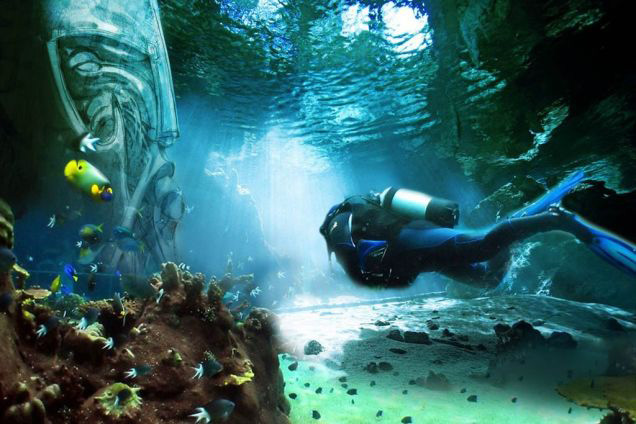
The network Douglas imagines is grand: at each of the first three planned properties, the reef territory will cover a five-acre plot with a mixture of open ocean floor and full-sized structures for exploration. Buildings will be constructed in a way to maximize fish and coral habitat; for the “Gods of the Maya” project in Mexico, full-scale replicas of Mayan stelae and other sculpture will not only showcase the country’s cultural heritage, but also provide plenty of nooks and crannies for critters.
To build these underwater resorts, Reef Worlds translates computer-based designs into full-scale, hand-finished foam blocks, which are then used to cast the molds for the final structures. Once on site, the molds are filled with a mixture of coral and basalt rock substrate, cured and submerged.
In Dubai, Douglas says the client initially wasn’t as concerned with the ecosystem restoration component as they were about simply having something to boost diving tourism in the country. But after being convinced that supporting the return of the brown spotted reef cod, a delicacy known locally as hamour, would also encourage divers to come swim with the popular fish, they asked Douglas to “Swiss cheese” the designs of the underwater city to give baby cod a place to hide and thrive. Reef Worlds is planning the release of two million baby hamour into the Dubai reef as part of the project.
Yet while revenue is the reason for the projects, it relies upon public passion to create the demand to protect them in the long term, Douglas says. 
“Once people have a more authentic experience, and engage with a reef on a fundamental level, it changes their whole focus and attitude,” Douglas says. “It’s cool to say that you went underwater and saw fish, but it’s important to learn why it’s there, and that it’s a replacement for what was once there. You’re now in participation to make it right, and make it better—even though it doesn’t make up for what was once there.”
Keith Mille is a fisheries biologist who has worked in the Florida Fish and Wildlife Conservation Commission’s artificial reef section for 14 years, overseeing the planning and construction of reef projects in the state. As public properties, Florida’s reefs are open for recreational fishing and diving, but are also used in research. Mille explains that man-made reefs often work best as a diversion to take pressure off of natural reefs.
That is a trend, statue-type deployments that are more focused on attracting people than fish,” he says. “But there’s a dichotomy there. If you’re improving fishing opportunities, sometimes the outcome of that is reduced biomass and increased fishing pressure. But on the other hand, by directing fishers and divers to an artificial reef site, you could potentially reduce traffic to more sensitive areas for an overall net benefit.”
But Mille notes that artificial reefs aren’t an adequate substitute for appropriate fisheries regulations for the protection of sensitive marine habitat.
Douglas, whose Shark Divers company created the Shark-Free/Shark Friendly Marinas Initiative, argues that prior to charging people to go dive with sharks, the idea of shark protection areas in the Pacific equivalent to the Australian continent was unimaginable.
“Unfortunately, there’s a very strong abhorrence for anything that’s for-profit,” Douglas says. “Who would have thought that in 2003 when we were yelling about sharks being killed that we’d have so much shark sanctuary today? But people who had been diving, who came home and put their pictures on the Internet and opened the minds of a thousand of their friends, drove all of it. To save a thing, you have to put money into it, and the best way to do that is charge people to go see it.”
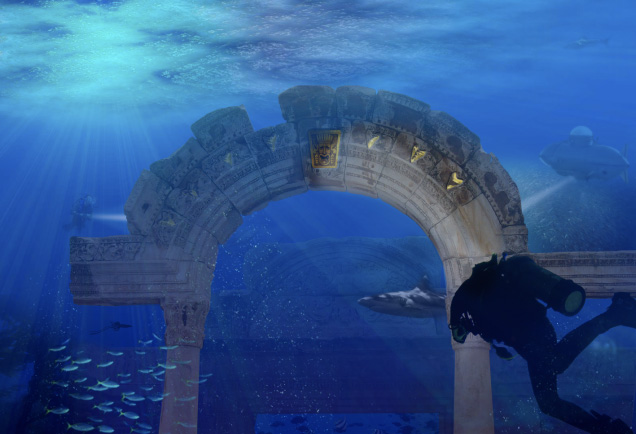
Estimated to cost around $6 million to build, the Pearl of Dubai project will include numerous “ruins” of buildings, dive-helmeted statues, avenues and trading markets to explore, including a large semi-enclosed coliseum that could be used for underwater meetings or weddings. Douglas says he expects construction to begin later this year. 

Reef Worlds designs new website

Resort artificial reef design
Reef Worlds designs and builds incredible, art inspired, artificial reef tourism sites for resort hotels. Near shore reef loss is a global problem affecting your bottom line as guests travel further afield to snorkel and dive on the world's last pristine reefs. 

Do you own a 5 star waterfront resort with a two star declining near shore reef zone? We can help you revitalize those underperforming tourism zones, you have acres of potential revenue development on your resort property. 

Our world class design team reimagines your resort waterfront with artificial reefs as monetized underwater playgrounds, offering the best of artificial reef habitat and structure with bespoke design that your clients will be thrilled to discover and explore. 

We offer artificial reef design you control, habitat we renew, giving your property a new lease on the acres of waterfront you have never considered as viable space before. 

Your voyage into art inspired reefs has begun, what's your vision?

Saturday, February 27, 2016

LA Film and TV Designers, Dive Site Developers, Marine Biologists Building Artificial Reefs

Reef Worlds Underwater ReefLos Angeles-based Reef Worlds, whose team includes film and television designers, dive-site developers, and marine biologists, are designing next generation sustainable reefs for tourism and the environment in a race to save inshore ocean habitat around the globe.
Environmental change has caused the loss of more than half the world’s reef building corals. Coral cover, a measure of the percentage of the seafloor covered by living coral, is now just 10-20 percent worldwide. The Caribbean, thought to be one of the more pristine global reef systems, has lost 80% of its coral cover in only the last 50 years.
CEO Patric Douglas notes that while scuba diving and snorkeling are a $3-billion-a-year business, most resort developments don’t offer much in the way of special underwater experiences. “Many five-star resorts have one-star waterfronts,” says Douglas. Reef Worlds estimates there are 500,000 square miles of resort oceanfront with limited appeal to adventurous tourists due to rampant habitat loss.
Worse yet, these zones have suffered decades of neglect as resort developers focused on land based amenities such as water parks and golf courses.
“Reef Worlds was established three years ago with the goal of working alongside resorts to create sustainable artificial reef systems that help reduce tourism pressures on natural reefs. Reef Worlds are fully monetized discrete mini-marine “protected areas” within the resort’s own footprint, allowing them to brand the signature underwater experiences of their guests while creating and fostering regional habitat,” says Douglas.
Reef Worlds have been promoting the economic and ecological benefits of what he calls “habitat tourism,” which would give resort owners a way to monetize the waters off their beaches, while relieving some of the pressure from aquatic tourists on natural underwater reef systems that are endangered or dying.
Reef-Worlds-Underwater-Arch
Artificial reefs have been around for decades. Most were created with everything from sunken battleships to old tires—and most, says Douglas, are boring. “Who wants to look at a concrete triangle?” he asks. Reef Worlds designs and creates “dynamic reefs” to attract sea life and tourism interest, making them places people actually want to explore, he says.
In Mexico, the company is developing an underwater art garden featuring 200 works of art that will take their cues from Mayan and Aztec iconography. Douglas calls this “Mayan Gods in 3D.”
Douglas says Reef Worlds will be able to bring in projects at 10-20% of the cost of a typical resort water theme park, which can run $70 million to build and $10 million a year to market and maintain. And unlike land based entertainment facilities Reef Worlds sites slowly transform over time into habitat for a wide range of wildlife and corals like a typical artificial reef.
Reef Worlds’ “Pearl of Dubai” project will be located in the waters around the World Islands development. Renderings suggest the park might be modeled after the mythic Lost City of Atlantis. Reef Worlds has five projects in varying stages of development in Dubai, Qatar, the Philippines, and Mexico.

Tourism Trend Setters – Attractions That Create Vacation Memories and Revenue

Global tourism is getting back on track and all indications are showing a return to vacation night stays at beachfront hotels and fractional ownership around the world. Once again the industry is grappling with the age old questions of consumer engagement and vacation memory creation branded to resort properties.
Artificial resort reef design

“It’s a no brainer for us,” says Dave Taylor Director of Development at Reef Worlds, an L.A based underwater design and development company.
“There’s an estimated 500,000 square miles of accessible ocean front sitting right off main stream hotel chains and fractional ownership resorts  that no one has built any engagement with. The resorts who own these spaces still consider the high tide mark their responsibility. The end result are waterfront spaces that no one wants to snorkel on, or dive on, worse yet spaces that wildlife, (the reason people engage with the water), are leaving because of environmental neglect.”
Dave Taylors design and build team are avid water users and have traveled extensively around the world to discover the state of resort waterfronts in 2012 and their report was not pretty. “We found old tires, garbage, sand bottoms, broken coral, and wildlife that was barely hanging on. In short not a place you would want to grab a snorkel kit and go explore and these were 5 Star developments and time share properties .”
Reef Worlds solution is simple. Take the concept of an artificial reef, typically rock tailings, rip rap, and or concrete shapes that had no tourism value and fundamentally redesign the concept to create entire worlds underwater for tourism and wildlife. Reef Worlds harnesses 5000 years of human design elements with a touch of Hollywood magic to deliver underwater experiential sites that capture and hold mass tourism within a resort developments own footprint while creating a haven for regional wildlife.
They are also designed as revenue generators from the day they are placed with on site.
Tourism Revenue 101
“Snorkel rentals have some compelling numbers behind them. A typical snorkel set rents for $20-30USD a day, and at just 100 sets a day you’re looking at close to a million dollars in revenue generation for the resort. Add to that habitat creation with the increase of bio mass and colorful fish to your waterfront. But the Holy Grail of Reef Worlds are the newly branded vacation memories for your clients and their entire family in a way that is practically maintenance free. Try getting all that from a land based water park.”
Reef Worlds is in design and build stage with several 20 acre waterfront sites with site openings in tandem with new developments at the end of 2014 and 2015.
“We’re breaking every tourism paradigm there is right now with Reef Worlds. Tourism is coming back in a big way and today’s client is not the same one we saw in 2007, they are networked, social media savvy, and want experiential adventures they can share easily with friends. They also want a return to wildlife engagement and that’s something we’re helping with one unique and iconic underwater site at a time.”
If You Build It
Habitat creation is important for regional wildlife. Many resorts worldwide are suffering from extensive habitat loss underwater. Reef Worlds builds the kind of large structures that attract soft coral growth, herbivorous fish, and schooling fish species. Reef Worlds design teams also employ marine biologists and fish ecologists to design underwater worlds that also act as instant habitat creation.
“The next decade will be all about who has the ability to create an emotional connection with their client base. After all, one beach is the same as the next beach and you can only add so many swimming pools and land based attractions before you start running out of space. Our message is simple, start building underwater and discover how easy it is re-engage your clients and get them to use social media to spread the word about your resorts.”
About Reef Worlds
At the intersection of art, science, and the environment is Reef Worlds. When a unique team of film and television designers, dive site developers, and marine biologists got together they dreamt of a better way to experience the undersea realm. 
The result was Reef Worlds. 
For more information about Reef Worlds:
Visit their website www.reefworlds.com
Call 323.863.5085
Send an email to developer@reefworlds.com

Waterfront Resorts Reborn: Discovering Dynamic Reefs and Revenue

It’s an open secret in the waterfront resort community. For the past 40 years resorts have considered little beyond the high tide mark. With the help of a unique environmental design team they are rediscovering acres of property, client engagement, and new sources of revenue.
Reef Worlds is my Los Angeles based Dynamic Reef Development Company, and we have recently discovered 500,000 square miles of premium resort development space sitting in front of some of the top luxury resorts on the planet.
After reviewing the state of resort waterfronts around the Caribbean we discovered 5 star properties with half star waterfronts, zones beyond the high tide mark where natural reefs, colorful fish, and habitat were essentially gone, replaced with some old tires, turtle grass, and dead coral and it is a global phenomenon.
Over the past 40 years while waterfront resorts have focused on land based amenities and water parks, the industry assumed the ocean, “would take care of itself.” Resort revenue areas that once attracted snorkelers and divers to the region would always be healthy and vibrant.
That’s just not the case, complex environments need to be looked after and tended to, the fact is the current state of waterfronts has never been worse and that affects the resort bottom line. People want to snorkel; they want to engage with the oceans and ocean wildlife and some of the most successful revenue building water programs involve wildlife like Stingray City in the Caymans for example. Today’s travelers want to create their own unique vacation content and share it via social media with their networks; no one wants to share images of an old tire underwater.
Reef Worlds Dynamic Reef teams survey resort waterfronts and wildlife potential and create made to order Dynamic Reef environments, harnessing 5000 years of iconic design elements create entire worlds underwater for snorkelers and divers to explore.
The fact is most resorts have at least 10-20 acres of usable space in front of their properties. Right now these spaces generate no revenue; they do nothing for social media, branding, or the regional environment. Now imagine these same spaces with carefully designed snorkel trails, environmentally safe habitat creation, and the look and feel of a Lost World to be discovered?
Dynamic Reefs vs Artificial Reefs
Dynamic Reefs allow waterfront resorts and developments to synergistically take design elements and branding from their property and place it in the oceans. Unlike artificial reefs, Dynamic Reefs focus on both the environment and tourism to create a conscious blend of revenue generation and environmental support. No two waterfront spaces are the same so the design and build must suit both regional wildlife and tourism needs.
This is how resorts will tackle the complex issues facing them over the next decade, by looking at their entire resort footprint and maximizing every aspect in a sustainable manner. At Reef Worlds we know what the underwater environment can look like and how habitat creation is good for not only colorful fish and corals, but increased tourism and engagement.”
Reef Worlds design teams imagine a world where miles of resorts coastlines around the world are transformed by Dynamic Reefs into mini marine protected areas that also serve tourism to create a better environment for future generations.
Reef Worlds help waterfront properties worldwide enhance their near shore waters, the ones closest to beach fronts with interactive and exciting man made designs elements placed underwater. Our vision is to create entire worlds underwater that inspire and are iconic. Reef Worlds are carefully placed in areas where resorts and developments have sand or grass bed bottoms that currently hold little interest to resort guests.

Our underwater sites are 100% neutral and do not harm the environment, rather they provide instant habitat for a wide variety of fish and coral life to begin near shore propagation. They can also be used as discreet set aside or mini marine protected areas capturing high volume tourism traffic while protecting natural reefs nearby.
About Reef Worlds
At the intersection of art, science, and the environment is Reef Worlds. When a unique team of film and television designers, dive site developers, and marine biologists got together they dreamt of a better way to experience the undersea realm. 
The result was Reef Worlds.
Visit us at www.reefworlds.com
Call 323.863.5085
Send an email developer@reefworlds.com

Sunday, April 12, 2015

Coral Reefs of Florida to Disappear by 2030 Due to Climate Change

The National Ocean and Atmospheric Administration (NOAA) states now that the coral reefs off of Florida’s southern coast will disappear by 2030 due to climate change – 12 years earlier than previously thought. 
Even though Florida lawmakers attempted to expunge the terms “climate change” and “global warming” from the lexicon of the legislative agenda, they have not eradicated the fact that there is a dire threat facing the state’s coral reefs. 
According to the NOAA’s new study, scientists have found that by 2030, the ocean water around Florida will reach a temperature warm enough to kill off massive underwater mountains of coral reefs, endangering the coastline and scores of different species of ocean-dwelling creatures.
The NOAA scientists explained that coral bleaching will cause the demise of the reefs when oceans are warmed to uninhabitable temperatures due to climate change. The is warming will cause the algae that inhabits the area around coral reefs to vacate the area in search of better conditions, which make the coral lose its vibrant, beautiful colors. Thus, leaving the coral a deadening white hue. Coral bleaching has occurred at an ever-increasing rate throughout the last few decades, becoming more chronic in the last 20 years. A previous study was done to assess the health of coral reefs located in the Caribbean and the Gulf of Mexico, which were found to be in a status that will leave them bleaching in the near future.
Increasing ocean temperatures in the Caribbean and the Gulf of Mexico will only aggravate the troubles Florida is facing in their coastal ecosystems. Frank Wasson, president of Spree Expeditions, stated the rising temperatures are very important, though they become more acute when knowing coral bleaching is going to be a serious factor in the future. Scientists state by mid-century, possibly even sooner, coral bleaching could affect the areas of Biscayne Bay, Dry Tortugas National Park, and the entirety Florida Keys. 
These are prime tourist destination areas that may suffer a decline in the years leading up to 2030 in visits when the coral reef become less vibrant than they are today, populated with a wide array of marine life and crystal clear waters, due to climate change.
Although it is one of the most vulnerable areas for rising sea levels and ocean temperatures, Florida citizens still remain on opposite sides of the political aisle when it comes to the debate on climate change. For example, back in March, Governor Rick Scott, a Republican, attempted to erase the terms “climate change” and “global warming” from being used by the Florida Department of Environmental Agency (FDEA) due to their association with artificial (man-made) global warming. 
Although the charge was not a formal eradication of the terms, those at the FDEA stated they were told to halt all rhetoric referring to the terms in official reports and at conferences. The ban sparked mass outrage among activists and scientists who deal with climate change across the county. They stated the political attitudes ignored a great scientific consensus.
Climate change does not only affect the coral reefs off the coast of Florida, but in many other areas around the world. Studies have shown that marine ecosystems in the Indian Ocean and western South Pacific waters have faced rising levels of coral bleaching outbreaks as temperatures become warmer. The NOAA stated climate change and the impacts it causes are the most dangerous threats to the world’s coral reefs and the corals maybe a thing of the past as of 2030.

Fish life key to healthy reefs - Let's build artificial reef habitat

A recent study has ascertained that robust fish life is key to healthy reefs. One strategy to bringing regional fish life back is providing them with new habitat and fishing restricted zones.
At Reef Worlds we have been championing the concept of Habitat Tourism reefs for resort hotels around the globe.
We could, with a little imagination, rehabilitate 1.5 million miles of coastlines with the help of mainstream resort hotel management companies.
Fish are the key ingredients in a new recipe to diagnose and restore degraded coral reef ecosystems, according to scientists from the Australian Institute of Marine Science, WCS, James Cook University, and other organizations in a new study in the journal Nature.
For overfished coral reef systems, restoring fish populations that perform key roles will in turn restore ecological functions critical to recovery. For moderately or lightly fished reefs, the recipe requires knowing which fish to catch, how many, and which to leave behind.
The authors assessed fish biomass and functional groups from more than 800 coral reefs worldwide and used them to estimate recovery periods for both lightly fished and overfished reefs. The scientists speculate that maintaining and restoring fish populations and the functions they provide can increase the resilience of reefs to large-scale threats such as climate change.
The coral reefs of the world are in crisis, endangered by a number of coastal threats such as overfishing, pollution, and coastal development as well as global threats such as climate change. According to the World Resources Institute, some 75 percent of the world’s coral reefs are now threatened and more than 20 percent have disappeared since climate and fishing disturbances have accelerated in the past 30 years. At the same time, only 27 percent of the world’s coral reefs are contained within marine protected areas.
"By studying remote and marine protected areas, we were able to estimate how much fish there would be on coral reefs without fishing, as well as how long it should take newly protected areas to recover,” said M. Aaron MacNeil, Senior Research Scientist for the Australian Institute of Marine Science and lead author on the study. “This is important because we can now gauge the impact reef fisheries have had historically and make informed management decisions that include time frames for recovery.”
“The methods used to estimate reef health in this study are simple enough that most fishers and managers can take the weight and pulse of their reef and keep it in the healthy range,” said Tim McClanahan, WCS Senior Conservationist and a co-author on the study. “Fishers and managers now have the ability to map out a plan for recovery of reef health that will give them the best chance to adapt to climate change.”

Coral reef experts agree that fishing is a primary driver in the degradation of reef function, which in turn has generated growing interest in finding fisheries management solutions to support reef resilience. Removing too many herbivorous and predatory fish species deprives coral reefs of critical ecosystem functions and the capacity to respond effectively to other disturbances. Knowing the right amount to leave behind can help local fisheries set clear limits to how many fish can be taken without threatening the ecosystem they rely on.
In response to this need, the study authors have created the first empirical estimate of coral reef fisheries recovery potential using data from 832 coral reefs in 64 locations around the world. The analysis included marine reserves and fishing closures as a control for estimating healthy fish biomass along with numerous sites along a spectrum of fishing intensity, from heavily fished reefs in the Caribbean to locations with low fishing rates and high fish “biomass” such as the Easter Islands. Despite the breadth of the data, some simple and consistent numbers emerged from the study.
Some of the key metrics uncovered in the study:
• According to the analysis, a coral reef with no fishing averages 1,000 kilograms per hectare of fish biomass. 

• The fish biomass threshold for a collapsed reef—overfished to the point of nearly total ecosystem failure—is 100 kilograms per hectare. 

• The most degraded reefs lack browsers (rudderfish, parrotfish, and surgeonfish), scraper/excavators (parrotfish), grazers (rabbitfish, damselfish), and planktivores (fusiliers), so the first steps in reef recovery depends on allowing these species and the services they provide to return. 

• Coral reefs that maintained 500 kilograms of fish biomass per hectare (about 50 percent of an average reef’s carrying capacity) were found to maintain ecological functions while sustaining local fisheries, providing fishers and marine managers with a critical target. 

• The authors found that 83 percent of the 832 reefs surveyed contained less than the 500 kilogram fish biomass threshold needed to maintain ecological integrity and stave off decline.

• The models generated time estimates needed for both unregulated and partially regulated coral reef fisheries to recovery; a moderately fished coral reef system can recover within approximately 35 years on average, while the most depleted ecosystems may take as long as 59 years with adequate protection.

The study also highlights the benefits of alternative fisheries restrictions, including bans on specific fishing gear such as small-mesh nets and restrictions on herbivorous species. Approximately 64 percent of coral reefs with fishing regulations (including bans on specific fishing gear such as small-mesh nets and restrictions on fishing of herbivorous species) were found to maintain more than 50 percent of their potential fish biomass.
“Reef fish play a range of important roles in the functioning of coral reef ecosystems, for example by grazing algae and controlling coral-eating invertebrates, that help to maintain the ecosystem as a whole,” said coauthor Nick Graham of James Cook University. “By linking fisheries to ecology, we can now make informed statements about ecosystem function at a given level of fish biomass.”
“The finding that gear restrictions, species selection or local customs can also contribute to fish population recovery is compelling. It demonstrates that managers can use a range of different management strategies in areas where it may not be culturally feasible to establish permanent marine reserves,” said coauthor Stacy Jupiter, WCS Melanesia Program Director. “Having a portfolio of management options provides flexibility to respond to local social and economic contexts. However, only completely closed no-take marine reserves successfully returned large predatory fish to the ecosystem."
This study was generously supported by the John D. and Catherine T. MacArthur Foundation, the Australian Institute of Marine Science, and the ARC Centre of Excellence for Coral Reef Studies.
The authors of the paper titled “Recovery potential of the world’s coral reef fishes” are: M. Aaron MacNeil of the Australian Institute of Marine Science; Nicholas A.J. Graham and Joshua E. Cinner of James Cook University; Shaun K. Wilson of the Australian Department of Parks and Wildlife; Ivor D. Williams of the NOAA Pacific Islands Fisheries Science Center; Joseph Maina of the Wildlife Conservation Society and Newcastle University; Steven Newman of Newcastle University; Alan M. Friedlander of the University of Hawaii; Stacy Jupiter of the Wildlife Conservation Society; Nicholas V.C. Polunin of Newcastle University; and Tim R. McClanahan of the Wildlife Conservation Society. 

Monday, March 23, 2015

LA Film and TV Designers, Dive Site Developers, Marine Biologists Building Artificial Reefs

Reef Worlds Underwater Reef
Los Angeles-based Reef Worlds, whose team includes film and television designers, dive-site developers, and marine biologists, are designing next generation sustainable reefs for tourism and the environment in a race to save inshore ocean habitat around the globe.
Environmental change has caused the loss of more than half the world’s reef building corals. Coral cover, a measure of the percentage of the seafloor covered by living coral, is now just 10-20 percent worldwide. The Caribbean, thought to be one of the more pristine global reef systems, has lost 80% of its coral cover in only the last 50 years.
CEO Patric Douglas notes that while scuba diving and snorkeling are a $3-billion-a-year business, most resort developments don’t offer much in the way of special underwater experiences. “Many five-star resorts have one-star waterfronts,” says Douglas. Reef Worlds estimates there are 500,000 square miles of resort oceanfront with limited appeal to adventurous tourists due to rampant habitat loss.
Worse yet, these zones have suffered decades of neglect as resort developers focused on land based amenities such as water parks and golf courses.
“Reef Worlds was established three years ago with the goal of working alongside resorts to create sustainable artificial reef systems that help reduce tourism pressures on natural reefs. Reef Worlds are fully monetized discrete mini-marine “protected areas” within the resort’s own footprint, allowing them to brand the signature underwater experiences of their guests while creating and fostering regional habitat,” says Douglas.
Reef Worlds have been promoting the economic and ecological benefits of what he calls “habitat tourism,” which would give resort owners a way to monetize the waters off their beaches, while relieving some of the pressure from aquatic tourists on natural underwater reef systems that are endangered or dying.
Reef-Worlds-Underwater-Arch
Artificial reefs have been around for decades. Most were created with everything from sunken battleships to old tires—and most, says Douglas, are boring. “Who wants to look at a concrete triangle?” he asks. Reef Worlds designs and creates “dynamic reefs” to attract sea life and tourism interest, making them places people actually want to explore, he says.
In Mexico, the company is developing an underwater art garden featuring 200 works of art that will take their cues from Mayan and Aztec iconography. Douglas calls this “Mayan Gods in 3D.”
Douglas says Reef Worlds will be able to bring in projects at 10-20% of the cost of a typical resort water theme park, which can run $70 million to build and $10 million a year to market and maintain. And unlike land based entertainment facilities Reef Worlds sites slowly transform over time into habitat for a wide range of wildlife and corals like a typical artificial reef.
Reef Worlds’ “Pearl of Dubai” project will be located in the waters around the World Islands development. Renderings suggest the park might be modeled after the mythic Lost City of Atlantis. Reef Worlds has five projects in varying stages of development in Dubai, Qatar, the Philippines, and Mexico.

Friday, February 20, 2015

75% of coral reefs in the Gulf have been lost, are there solutions?

A recent article in Gulf News has outlined some stunning statistics. For oceanfront resort developers in the UAE region and beyond massive reef loss is a threat to tourism, sustainability, fisheries and an entire way of life - are there solutions?
At least 75 per cent of coral reefs in Gulf waters have been lost due to mismanagement of marine resources and global warming, according to statistics revealed on the final day of the Coral Reefs of Arabia Conference held at New York University Abu Dhabi (NYUAD).
"We actually know enough science about [coral] reefs to able to resolve the question, but it's not a question for science any more. It's a question of governance, management, human interaction and relationships," Professor Charles Sheppard of Warwick University said.
75% of coral reefs in the Gulf have been lost, are there solutions?
Sheppard highlighted how man made conditions combined with global warming have affected the reefs.
"We've got what I call the local group of impacts, all the usual ones, sewage, overfishing, sedimentation, and construction. Added to that we have the global group, acidification and warming caused by the carbon dioxide blankets. I'm often asked which is the most important of all these [in harming the coral reefs] and you just can't answer that, it depends on what the local pressures are, and when it comes to the global group, I suspect it's the warming that's causing the immediate killing [of coral reefs]."
Sheppard recommended that steps be taken to reverse some of the above trends, such as banning landfills in coral reef areas, as well as regulations within the fishing industries, and for scientific research on the issue to be taken seriously and acted on through government policies in order to protect the reefs.
In Los Angeles a unique artificial reef company creating Habitat Tourism for resort developers in the region is unveiling a new project called the Pearl of Dubai to help stem reef loss and created new habitat for a wide variety of fauna like the Hamor (Epinephelus chlorostigma).
With the loss of coral reefs also comes the loss of species that are dependent on the reefs for their survival, with several species under threat according to Professor John Bartz from the University of Miami.
"Not surprisingly coastal development affected 17 species, then going after that was climate change affecting six species, and then fisheries surprisingly having fewer threats to the species [four species under threat]. Of the coral reef-dependent species, once we do the reassessment [of species under threat] I would imagine that the majority of those are not doing so well, and of course coastal development is the most prevalent threat to the species here [Gulf]."
One method of protection that was raised during the conference was the implementation of marine-protected areas, advocated by Professor Hanneke Van Lavieren, from the United Nations University Institute for Water, Environment and Health. She said, "We've heard about the multitude of serious threats that the marine environment here faces, both natural and human induced, so the need to protect at least whatever is left makes sense. One of the tools available to do this is marine-protected areas. If well established and managed, then a network of marine protected areas can be quite effective in protecting some parts of our marine environment."
According to Professor Lavieren, the marine protected areas can be established to protect several different aspects of the marine environment. "They can be established to protect biodiversity, specific species or habitats. They can be established to maintain ecosystem functioning, and they can also provide refuge to a threatened species. More recently we hear more about their role in enhancing the resilience of coastal systems and reducing the risk for disasters."
More than 20 sites in the UAE have already been designated as marine protected areas according to Lavieren.

Tuesday, January 27, 2015

Resort Based Tourism Reefs, Solutions to Near Shore Reef Loss?

Resorts need to "care for reefs"
Loss of reefs is a serious economic problem in the Caribbean where large populations depend on fishing and tourism.

Coal reefs provide a vital home for marine creatures, acting as a nursery for fish and a food resource for higher food chain predators such as sharks and whales.

 Over the last 50 years 80% of the corals have been lost due mainly coastal development and pollution. They now are also threatened by invasive species, global warming and the early effects of ocean acidification — it's the perfect storm.

Resort Based Dynamic Reefs

Art and sculpture reefs are a subset of manufactured reefs, and are usually constructed with the purpose of attracting tourists and creating new habitat. For the past 50 years resort developers and management companies have abandoned everything past the high tide mark assuming, incorrectly, that reefs and regional wildlife would continue to thrive.

They have not.

The creation of resort based reefs designed for both tourism and the environment serve a dual purpose. In addition to increased marine life populations, new dive sites lead to new economic opportunities. Reefs that gain larger, healthier populations due to the placement of artificial reefs, and the addition of aesthetically interesting structures are a magnet for snorkelers, recreational scuba divers, and photographers.

For many developing coastal nations, artificial reefs provide a cheap option to attract tourists in an otherwise poor market. The placement of artificial reefs leads to a long term profit, where tourists will continue to visit, and fisheries will see increased populations and production.

If placed close to shore, in an easily accessible area, increased and easily located fish populations attract tourists interested in fishing. An increased volume of tourists attracted by the reefs will create a demand for hotels, restaurants, and other markets associated with tourism.

It is time to reconsider resort engagement with the oceans in a fundamental way with Dynamic Reefs. 

Thursday, January 22, 2015

Sudden Reef Loss, Tourism Disaster or Opportunity?

Resort tourism reefs in decline
Coral reefs are the building blocks of coastal marine life. Whether they protect developed areas from storm systems, create diverse fish stocks, or support a global multi-billion dollar tourism industry. The ever increasing loss of these complex systems is acutely felt, and 2015 will usher in the largest geographic loss of corals ever recorded according to climate scientists and marine researchers.

For waterfront resort developments around the world the loss of coral reefs has been largely ignored for the past 50 years. Resort developers have abandoned any development beyond the high tide mark. Look at any typical waterfront resort development in 2015 and you'll find deep investments in land based infrastructure with intricate pools and water parks, gardens, and almost no engagement with the oceans beyond a few kayaks, a ubiquitous sail boat, and a struggling dive program that has long been sub contracted out to a private company.

90% of global waterfront resorts feature C and D class reef systems and their immediate future as productive ecological spaces is waning. With their loss goes a worldwide $3 billion dollar dive and snorkel tourism market, increasingly migrating further afield creating new development in regions still considered pristine. The Maldives would be a prime example of this destination trend.

Artificial Reefs

Artificial reefs are a proven technology to rehabilitate regions suffering from coral loss and habitat degradation. The creation of artificial reefs at strategic locations offers new habitat opportunities attracting fish, coral, and tourism. Over a short time frame, submerged structures decrease demand on over-used and over-stressed natural coral reefs in tourism regions and allow for developers to create inexpensive water engagement spaces on their own resort footprint.

The State of Florida has one of the most robust and forward thinking AR programs on the planet and by any metric, both tourism and habitat rehabilitation, the decades long program has been wildly successful becoming a $253 million dollar cornerstone for Florida tourism.

Latest Trends, Innovation, Style

Uniquely designed "habitat tourism" site concept
The latest developments in artificial reefs have taken the concept of static and solely fish habitat based structures with little tourism interest and radically changed the paradigm. New technologies and artists are leading an Artificial Reef Revolution into a new phase called - Dynamic Reefs.

This artful design for underwater engagement comes from the need to create sustainability loops where the artificial reef becomes "the tourism attraction" and increased tourism revenues help add more habitat and sustain regional projects like Mangrove replanting.

Leading this revolution are a series of unique sites from Mexico to Dubai that are building for both the environment and tourism and the industry is taking notice along with green media, social media, and traditional media outlets.

The rapid global decline of coral reefs is having stunning ecological and economic consequences that will resonate over the next decade and beyond. Healthy coral ecosystems support local businesses and economies, as well as provide jobs through tourism and recreation.

Every year, millions of scuba divers and snorkelers visit coral reefs to enjoy their decreasing sea life.

Unprotected/monetized reefs
Even more tourists visit the beaches protected by disappearing reefs. Local economies receive billions of dollars from these visitors to reef regions through diving tours, recreational fishing trips, hotels, restaurants, and other businesses based near reef ecosystems. One estimate places the total global value of coral-reef based recreation and tourism at $9.6 billion (NOAA 2013) of the total global net benefit of coral reefs.

It is in this environment that billions of development dollars are being spent on waterfront resort projects that refuse to acknowledge anything past the high tide mark.

Think about that for a moment.

Resort developers typically ensure that every square inch of land based development property has a propose. Water parks, restaurants, rooms, entertainment facilitates, golf courses, and yet around the world millions of acres of waterfront resort space is turning into broken graveyards of dead coral, few fish, and garbage - yes garbage.

The time for a change is here, the recognition that resort developers have an additional two to five acres of revenue generating spaces past the high tide mark is the start of an undersea revolution. One where developments look past the high tide mark into unique underwater engagement projects that benefit both the oceans and their bottom line.

With the help of the next generation of marine engineers, artists, and industry visionaries, over two million square miles of global waterfront resort development spaces can become productive and sustainable.

Welcome to the Future of Tourism.