Showing posts with label travel trends. Show all posts

Sunday, March 20, 2016

Resort Hotel Artificial Reefs, Building New Habitat and Revenues

Reef Worlds Pearl of Dubai
Reef Worlds take on artificial reefs adds a new paradigm: their installations are designed first for customers with credit cards, and then for ones with real fins. 
Primarily intended to provide tourists with a new adventure-based experience, and in places where they are already present in great numbers, CEO Patric Douglas hopes the increased traffic will create a positive feedback loop. 
By making reef ecosystems more accessible to more people, a large part of the goal is to drive a greater demand for conservation of those natural resources.
Diving is big business, and coral reefs a big part of it. A 2013 National Oceanic and Atmospheric Administration (NOAA) report pegs the economic value of all coral reefs in the United States and its territories at $202 million dollars annually, with half of that figure accounted for by tourism dollars. Douglas thinks this kind of buying muscle can be built up around the world, creating not only a novel and authentic adventure experience but also a powerful tool for restoring critical ocean habitat.
Gone are the days when a visitor to a Caribbean resort can walk out on a near-shore snorkeling tour and see coral reefs teeming with life. Today, that excursion usually involves a lengthy boat ride. But hotels at tropical resorts are still trying to one-up each other in the battle royale for tourism dollars: the swimming-pool wars of the 1980s and 1990s gave way to full-blown water parks like Bermuda’s Atlantis, yet the resorts themselves seemed to completely ignore their offshore assets, Douglas observed. 
“My team and I were lamenting that at every hotel resort we went to in the Mediterranean and Mexico, the near-shore reef system was just gone, like a nuke went off,” Douglas says. “So the question became, what can we do to rehabilitate that, and what’s the tourism angle? All of these resorts are 200 feet from the ocean, but have nothing to do with the ocean.”
Douglas, a self-described “environmentalist masquerading as a developer,” says coastal resort hotels are uniquely positioned to grow their business by developing recreational opportunities in the water, but also to defend the natural resources there. By motivating local residents to help protect the reefs, they can help tourism grow and increase incomes for everyone involved.
“This is a major question: how do you stop the local fishermen from making a living?” Douglas says. “You can’t pay them not to fish, especially when they’re dirt poor and they need to go out and scavenge whatever they can get. But I’ve been to enough of these hotels to know that most of the people in the community are working there, and when you explain to them what the reef [can do for tourism], they’ll tell their family, don’t fish there. It’s not good for us or the community.”
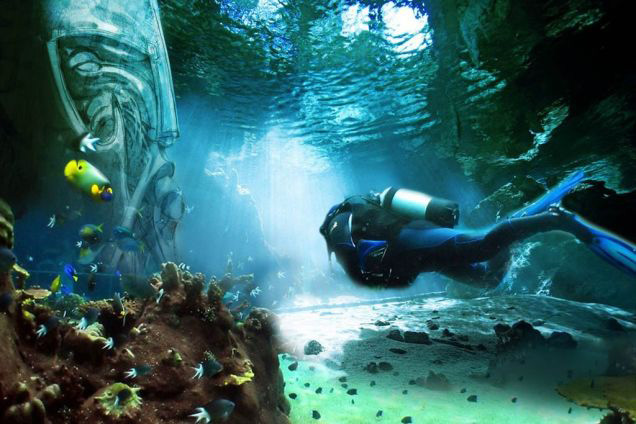
The network Douglas imagines is grand: at each of the first three planned properties, the reef territory will cover a five-acre plot with a mixture of open ocean floor and full-sized structures for exploration. Buildings will be constructed in a way to maximize fish and coral habitat; for the “Gods of the Maya” project in Mexico, full-scale replicas of Mayan stelae and other sculpture will not only showcase the country’s cultural heritage, but also provide plenty of nooks and crannies for critters.
To build these underwater resorts, Reef Worlds translates computer-based designs into full-scale, hand-finished foam blocks, which are then used to cast the molds for the final structures. Once on site, the molds are filled with a mixture of coral and basalt rock substrate, cured and submerged.
In Dubai, Douglas says the client initially wasn’t as concerned with the ecosystem restoration component as they were about simply having something to boost diving tourism in the country. But after being convinced that supporting the return of the brown spotted reef cod, a delicacy known locally as hamour, would also encourage divers to come swim with the popular fish, they asked Douglas to “Swiss cheese” the designs of the underwater city to give baby cod a place to hide and thrive. Reef Worlds is planning the release of two million baby hamour into the Dubai reef as part of the project.
Yet while revenue is the reason for the projects, it relies upon public passion to create the demand to protect them in the long term, Douglas says. 
“Once people have a more authentic experience, and engage with a reef on a fundamental level, it changes their whole focus and attitude,” Douglas says. “It’s cool to say that you went underwater and saw fish, but it’s important to learn why it’s there, and that it’s a replacement for what was once there. You’re now in participation to make it right, and make it better—even though it doesn’t make up for what was once there.”
Keith Mille is a fisheries biologist who has worked in the Florida Fish and Wildlife Conservation Commission’s artificial reef section for 14 years, overseeing the planning and construction of reef projects in the state. As public properties, Florida’s reefs are open for recreational fishing and diving, but are also used in research. Mille explains that man-made reefs often work best as a diversion to take pressure off of natural reefs.
That is a trend, statue-type deployments that are more focused on attracting people than fish,” he says. “But there’s a dichotomy there. If you’re improving fishing opportunities, sometimes the outcome of that is reduced biomass and increased fishing pressure. But on the other hand, by directing fishers and divers to an artificial reef site, you could potentially reduce traffic to more sensitive areas for an overall net benefit.”
But Mille notes that artificial reefs aren’t an adequate substitute for appropriate fisheries regulations for the protection of sensitive marine habitat.
Douglas, whose Shark Divers company created the Shark-Free/Shark Friendly Marinas Initiative, argues that prior to charging people to go dive with sharks, the idea of shark protection areas in the Pacific equivalent to the Australian continent was unimaginable.
“Unfortunately, there’s a very strong abhorrence for anything that’s for-profit,” Douglas says. “Who would have thought that in 2003 when we were yelling about sharks being killed that we’d have so much shark sanctuary today? But people who had been diving, who came home and put their pictures on the Internet and opened the minds of a thousand of their friends, drove all of it. To save a thing, you have to put money into it, and the best way to do that is charge people to go see it.”
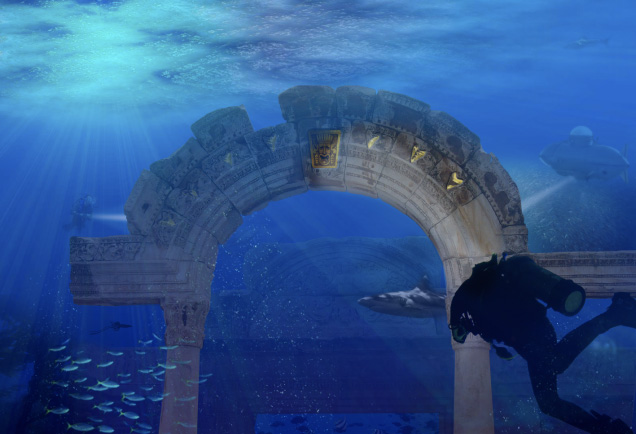
Estimated to cost around $6 million to build, the Pearl of Dubai project will include numerous “ruins” of buildings, dive-helmeted statues, avenues and trading markets to explore, including a large semi-enclosed coliseum that could be used for underwater meetings or weddings. Douglas says he expects construction to begin later this year. 

Reef Worlds designs new website

Resort artificial reef design
Reef Worlds designs and builds incredible, art inspired, artificial reef tourism sites for resort hotels. Near shore reef loss is a global problem affecting your bottom line as guests travel further afield to snorkel and dive on the world's last pristine reefs. 

Do you own a 5 star waterfront resort with a two star declining near shore reef zone? We can help you revitalize those underperforming tourism zones, you have acres of potential revenue development on your resort property. 

Our world class design team reimagines your resort waterfront with artificial reefs as monetized underwater playgrounds, offering the best of artificial reef habitat and structure with bespoke design that your clients will be thrilled to discover and explore. 

We offer artificial reef design you control, habitat we renew, giving your property a new lease on the acres of waterfront you have never considered as viable space before. 

Your voyage into art inspired reefs has begun, what's your vision?

Saturday, February 27, 2016

Patric Douglas CEO Reef Worlds

Patric Douglas
Patric Douglas Reef Worlds CEO
For 15 years, I served as the CEO of Shark Diver where we pioneered cage-diving with great white sharks. We were the first commercial shark diving company in the U. S. to initiate, develop, and support research of white sharks at Isla Guadalupe in Mexico. 

We went on to initiate strong global shark conservation programs like the Shark-Free Marinas Initiative in tandem with our operations sites in the Bahamas. The goal was clear: be advocates for sharks and the diving industry, while providing exciting, but safe shark encounters to our divers, the mainstream media, and research partners. We called it Conservation Shark Diving.

We learned that the first step to addressing an out-of-sight, out-of-mind problem in the oceans is to get people to directly engage. It sounds simple in retrospect, but at the turn of the millennium, getting diving instructors, SCUBA schools, and other dive groups really interested in traveling to a remote Mexican island to jump in 500 ft of water in a shark cage and go face to face with an 18-ft great white shark was a tall order.

It worked. Shark divers are more likely to give back to the environment in real and tangible ways, including site preservation efforts, shark site research support, and positive media efforts for sharks. When we started Shark Diver, sharks where not viewed as charismatic mega-fauna. Sharks were the enemy; divers didn’t mingle with sharks. They carried big knives on the chance of encountering one. Fifteen years later, after some heavy lifting by Shark Diver and a number of other companies, sharks are now viewed as charismatic mega-fauna. They are the darlings of the conservation world, and there are a multitude of groups trying to protect and save sharks or bring awareness to destructive practices such as shark finning. It’s been a spectacular transformation. 

The Jeweled Belt 

After 15 years at Shark Diver, I took a year off, sold that company, and sat down with my new team at Reef Worlds to figure out how we could apply these same principals to what natural resource oceanographer Sylvia Earle has called “a jeweled belt around the middle of the planet.” 

We started Reef Worlds three years ago to address the out-of-sight, out-of-mind global issue of reef loss. We want to create sustainable artificial reef systems that help reduce tourism pressures on natural reefs. If that wasn’t enough good news, we aren’t operating at a loss. Reef Worlds, the products, are fully monetized, discrete mini-marine “protected areas” within the resort’s own footprint, allowing them to brand a signature experience for their guests, while also creating and fostering regional habitat.

Coral reefs are the rain forests of the sea. While regulations from NOAA and international bodies can help protect coral species, more needs to be done to raise awareness outside of the ocean science community. According to NOAA’s Reef Watch Program, coral reefs provide habitat for approximately 25% of all sea dwelling fish species. The problem is, reefs are disappearing. We are losing tens of thousands of square miles of coral reefs to ocean acidification, global warming pressures, point source run off, and negative human interactivity with reefs. Right now, across the world, we’re looking at 500,000 square miles of these waterfront spaces that are endangered due to habitat loss. And if we don’t do anything, the problem is only expected to worsen.

Reef Worlds’ projects specifically deal with the latter two negative effects on coral reefs: 1) point source run off, including coastal dredging, farm runoff, and wastewater from human settlement; and 2) negative human interactivity, which can include overfishing, damage from oceangoing vessels, pollution discharges, and irresponsible diving. We decided to focus on resorts and resort developers because they have, on any given day around the world, the most people interacting with the oceans—the place where we can have the most immediate impact is at resorts. Right now, not enough is being done to communicate with these individual ocean explorers. We’re not promoting a message to them; we’re not teaching them; we’re not doing anything but letting them interact with oceans. Worse yet, and this Was the staggering thing we discovered, is that for the last 50 years, developers have considered nothing past the high tide mark. This is really kind of ironic when you consider that they spend millions on water parks, golf courses, and manicured gardens. Yet we’ve seen, time and time again, five star resorts with one star waterfronts or nearshore reef areas. They literally abandoned their ocean fronts and, like anything if you’re not tending to it or paying attention, they’ve gone into disrepair.

Shocking Resort Facts

1. Only 2% of four and five star hotel brands have a coral conservation policy.

2. Only 1% of four and five star resort hotel brands have coral conservation projects.

3. Under 1% of four and five star resort hotels have coral education/outreach projects.

4. Under 1% of four and five star resorts have a relationship with regional coral NGOs.

Dynamic Reefs 

We build reef worlds with two clients in mind: one with fins and the other with credit cards. We’ve seen octopi living in cola bottles; we’ve seen snapper living on old broken pier pilings. These creatures are making a utilitarian choice and not an aesthetic one. But the consumers with the credit cards do care about aesthetics— the consumer—and we are using that to drive the development of these artificial reefs. If you can show resorts a financial paradigm where it is worthwhile for them to invest in their waterfronts and to spend money creating a habitat that their clients will love, while at the same time showing them that they can make money doing it, then you have won the battle. This is the key. If we can get to the point where folks are paying resorts to go and explore Atlantis underwater… if this development also acts as habitat for marine species…then we also get to share our message of conservation, much like what has happened with recreational whale watching and shark diving.

In this case, we are talking about tens of millions of people each year who utilize the oceans. If you can show resort visitors the kind of diverse and vibrant life a reef supports, then you can spark an interest in the importance of global coral reef conservation. You can educate visitors, telling them that the reason we built these places is because the in-shore reefs are already gone and explain in concrete terms that the global Reefs are crucial to ocean sustainability. We can even educate them about what we need to do to mitigate damage to global reefs. Direct interaction between consumer and reef starts this vital conversation.

It’s not just resorts. We’re talking about cruise lines as well. The millions of passengers each year who travel to cruise lines destinations are not being messaged about reef restoration at all. Take any of the 2,000 people that walk off a major cruise line and ask them what they know about reefs. Chances are, they’ll say, “I went snorkeling on one. It was beautiful.” We need people to come back and say, “Yeah, I went snorkeling and it’s in bad condition and we need to help.” 

Our team at Reef Worlds includes some of the best film and television designers, dive-site developers, and marine biologists. If we can take the lessons we learned from 15 years of casting light on an out-of-sight, out-ofmind problem like shark finning to where someone in Missouri feels connected and activated to help, we will be just as successful with coral reefs. In spite of the promise, we still have some convincing to do. We went to the Caribbean in 2009 and pitched our plan, but the Caribbean wasn’t ready. So we went to the United Arab Emirates—specifically to Dubai and Qatar—and they are very interested in this concept. We are currently building two sites there and are in the process of designing one in the Philippines as well as one in Mexico.

Our “Pearl of Dubai” project is set to be the world’s largest underwater theme park—yet construction costs are projected at a fraction of the cost of a typical resort water theme park. Because of its organic element, the site will evolve over time to provide habitat for a wide range of corals and other marine species. Our partners in Dubai understand that tourism is a long-term issue, and they are building for habitat tourism that stretches from the near-term to 100 years in the future. It’s remarkable that they are taking the best ideas from non-government organizations and the ocean world and applying them now.

We need this in the Caribbean, where there has already been an estimated 80% coral loss. Habitat loss and coral bleaching are major issues there and, unless the region invests now in restoring habitat, I’m fearful that we are going to lose everything. It’s a region that just can’t afford this loss— economically or ecologically. 

Another place that really needs coral rehabilitation is the Philippines. Entire coast lines are dead there. It’s a problem for the fishing industries, for typhoon and coastal flooding mitigation, and for the culture as a whole. These coastlines desperately need tourism money. The easiest approach would have been for them to tap into the $3 billion snorkel market, but now their natural reefs are gone. What they need to do now is invest in rehabilitating their reefs and construct dynamic structures to bring back the wildlife and reseed coral on them. They’re not going to get there with traditional artificial reef objects—like triangles or balls. These generate zero tourism interest. Instead, developers need a blended product that includes “ancient temples beneath the sea” and objects that stimulate the imagination of tourists culturally. On top of that, we can add other products in order to fully rehabilitate these sites. The finished product: mini marine protected areas.

Our pitch to resort developers and long-chain resort owners and managers is very simple: you have tens of thousands of useable acres right on your resort, within its existing footprint. We are here to help you monetize those spaces, create new habitats, and educate your people. Everybody wins. We’re back in the Caribbean now with a project in Mexico where we the theme is the Mayan Gods in 3D; the end result is the same—creating a sustainable reef system that profits investors and educates the public. 

A Marketplace Solution 


Even though there is a lot of negative news right now about coral reefs, there is also a bright new future. You can just sit on the sidelines and say the world is going to hell in a hand basket or you can come up with marketplace solutions that really work. Artificial reefs work; dynamic reefs work even better, especially when they are applied to tourism. Distilling the lessons we learned from the last 15 years into a repeatable template for coral reefs and placing this product in regions that have reef systems needing rehabilitation will work. We can bring these reefs to market, and we can do it in such a way that everybody wins—from the resort owners on down to the most delicate, endangered marine species.

Reef Worlds is educating and reshaping attitudes of resort developers regarding the intrinsic values of reef systems off resort waterfronts. By harnessing the latest technologies and providing richer tourism experiences, we can build dynamic reef environments that allow natural reef systems to regenerate and thrive all over the world. Meanwhile, we can also engage regional and international conservation groups and foster synergistic conservation relationships for future tourism developments.

Reef system loss equals billions in lost tourism revenue. By setting the global stage for the creation of underwater habitat tourism, we can begin to stem destruction and habitat loss while providing resort developers with new revenue, green media, experiential client engagement, and new conservation channels. Simply put, Reef Worlds represents the future of water based resort tourism.

To learn about coral conservation and access, visit coralreef.noaa.gov. For more on Reef Worlds, including their latest projects visit www.reefworlds.com.

Sunday, April 12, 2015

Coral Reefs of Florida to Disappear by 2030 Due to Climate Change

The National Ocean and Atmospheric Administration (NOAA) states now that the coral reefs off of Florida’s southern coast will disappear by 2030 due to climate change – 12 years earlier than previously thought. 
Even though Florida lawmakers attempted to expunge the terms “climate change” and “global warming” from the lexicon of the legislative agenda, they have not eradicated the fact that there is a dire threat facing the state’s coral reefs. 
According to the NOAA’s new study, scientists have found that by 2030, the ocean water around Florida will reach a temperature warm enough to kill off massive underwater mountains of coral reefs, endangering the coastline and scores of different species of ocean-dwelling creatures.
The NOAA scientists explained that coral bleaching will cause the demise of the reefs when oceans are warmed to uninhabitable temperatures due to climate change. The is warming will cause the algae that inhabits the area around coral reefs to vacate the area in search of better conditions, which make the coral lose its vibrant, beautiful colors. Thus, leaving the coral a deadening white hue. Coral bleaching has occurred at an ever-increasing rate throughout the last few decades, becoming more chronic in the last 20 years. A previous study was done to assess the health of coral reefs located in the Caribbean and the Gulf of Mexico, which were found to be in a status that will leave them bleaching in the near future.
Increasing ocean temperatures in the Caribbean and the Gulf of Mexico will only aggravate the troubles Florida is facing in their coastal ecosystems. Frank Wasson, president of Spree Expeditions, stated the rising temperatures are very important, though they become more acute when knowing coral bleaching is going to be a serious factor in the future. Scientists state by mid-century, possibly even sooner, coral bleaching could affect the areas of Biscayne Bay, Dry Tortugas National Park, and the entirety Florida Keys. 
These are prime tourist destination areas that may suffer a decline in the years leading up to 2030 in visits when the coral reef become less vibrant than they are today, populated with a wide array of marine life and crystal clear waters, due to climate change.
Although it is one of the most vulnerable areas for rising sea levels and ocean temperatures, Florida citizens still remain on opposite sides of the political aisle when it comes to the debate on climate change. For example, back in March, Governor Rick Scott, a Republican, attempted to erase the terms “climate change” and “global warming” from being used by the Florida Department of Environmental Agency (FDEA) due to their association with artificial (man-made) global warming. 
Although the charge was not a formal eradication of the terms, those at the FDEA stated they were told to halt all rhetoric referring to the terms in official reports and at conferences. The ban sparked mass outrage among activists and scientists who deal with climate change across the county. They stated the political attitudes ignored a great scientific consensus.
Climate change does not only affect the coral reefs off the coast of Florida, but in many other areas around the world. Studies have shown that marine ecosystems in the Indian Ocean and western South Pacific waters have faced rising levels of coral bleaching outbreaks as temperatures become warmer. The NOAA stated climate change and the impacts it causes are the most dangerous threats to the world’s coral reefs and the corals maybe a thing of the past as of 2030.

Fish life key to healthy reefs - Let's build artificial reef habitat

A recent study has ascertained that robust fish life is key to healthy reefs. One strategy to bringing regional fish life back is providing them with new habitat and fishing restricted zones.
At Reef Worlds we have been championing the concept of Habitat Tourism reefs for resort hotels around the globe.
We could, with a little imagination, rehabilitate 1.5 million miles of coastlines with the help of mainstream resort hotel management companies.
Fish are the key ingredients in a new recipe to diagnose and restore degraded coral reef ecosystems, according to scientists from the Australian Institute of Marine Science, WCS, James Cook University, and other organizations in a new study in the journal Nature.
For overfished coral reef systems, restoring fish populations that perform key roles will in turn restore ecological functions critical to recovery. For moderately or lightly fished reefs, the recipe requires knowing which fish to catch, how many, and which to leave behind.
The authors assessed fish biomass and functional groups from more than 800 coral reefs worldwide and used them to estimate recovery periods for both lightly fished and overfished reefs. The scientists speculate that maintaining and restoring fish populations and the functions they provide can increase the resilience of reefs to large-scale threats such as climate change.
The coral reefs of the world are in crisis, endangered by a number of coastal threats such as overfishing, pollution, and coastal development as well as global threats such as climate change. According to the World Resources Institute, some 75 percent of the world’s coral reefs are now threatened and more than 20 percent have disappeared since climate and fishing disturbances have accelerated in the past 30 years. At the same time, only 27 percent of the world’s coral reefs are contained within marine protected areas.
"By studying remote and marine protected areas, we were able to estimate how much fish there would be on coral reefs without fishing, as well as how long it should take newly protected areas to recover,” said M. Aaron MacNeil, Senior Research Scientist for the Australian Institute of Marine Science and lead author on the study. “This is important because we can now gauge the impact reef fisheries have had historically and make informed management decisions that include time frames for recovery.”
“The methods used to estimate reef health in this study are simple enough that most fishers and managers can take the weight and pulse of their reef and keep it in the healthy range,” said Tim McClanahan, WCS Senior Conservationist and a co-author on the study. “Fishers and managers now have the ability to map out a plan for recovery of reef health that will give them the best chance to adapt to climate change.”

Coral reef experts agree that fishing is a primary driver in the degradation of reef function, which in turn has generated growing interest in finding fisheries management solutions to support reef resilience. Removing too many herbivorous and predatory fish species deprives coral reefs of critical ecosystem functions and the capacity to respond effectively to other disturbances. Knowing the right amount to leave behind can help local fisheries set clear limits to how many fish can be taken without threatening the ecosystem they rely on.
In response to this need, the study authors have created the first empirical estimate of coral reef fisheries recovery potential using data from 832 coral reefs in 64 locations around the world. The analysis included marine reserves and fishing closures as a control for estimating healthy fish biomass along with numerous sites along a spectrum of fishing intensity, from heavily fished reefs in the Caribbean to locations with low fishing rates and high fish “biomass” such as the Easter Islands. Despite the breadth of the data, some simple and consistent numbers emerged from the study.
Some of the key metrics uncovered in the study:
• According to the analysis, a coral reef with no fishing averages 1,000 kilograms per hectare of fish biomass. 

• The fish biomass threshold for a collapsed reef—overfished to the point of nearly total ecosystem failure—is 100 kilograms per hectare. 

• The most degraded reefs lack browsers (rudderfish, parrotfish, and surgeonfish), scraper/excavators (parrotfish), grazers (rabbitfish, damselfish), and planktivores (fusiliers), so the first steps in reef recovery depends on allowing these species and the services they provide to return. 

• Coral reefs that maintained 500 kilograms of fish biomass per hectare (about 50 percent of an average reef’s carrying capacity) were found to maintain ecological functions while sustaining local fisheries, providing fishers and marine managers with a critical target. 

• The authors found that 83 percent of the 832 reefs surveyed contained less than the 500 kilogram fish biomass threshold needed to maintain ecological integrity and stave off decline.

• The models generated time estimates needed for both unregulated and partially regulated coral reef fisheries to recovery; a moderately fished coral reef system can recover within approximately 35 years on average, while the most depleted ecosystems may take as long as 59 years with adequate protection.

The study also highlights the benefits of alternative fisheries restrictions, including bans on specific fishing gear such as small-mesh nets and restrictions on herbivorous species. Approximately 64 percent of coral reefs with fishing regulations (including bans on specific fishing gear such as small-mesh nets and restrictions on fishing of herbivorous species) were found to maintain more than 50 percent of their potential fish biomass.
“Reef fish play a range of important roles in the functioning of coral reef ecosystems, for example by grazing algae and controlling coral-eating invertebrates, that help to maintain the ecosystem as a whole,” said coauthor Nick Graham of James Cook University. “By linking fisheries to ecology, we can now make informed statements about ecosystem function at a given level of fish biomass.”
“The finding that gear restrictions, species selection or local customs can also contribute to fish population recovery is compelling. It demonstrates that managers can use a range of different management strategies in areas where it may not be culturally feasible to establish permanent marine reserves,” said coauthor Stacy Jupiter, WCS Melanesia Program Director. “Having a portfolio of management options provides flexibility to respond to local social and economic contexts. However, only completely closed no-take marine reserves successfully returned large predatory fish to the ecosystem."
This study was generously supported by the John D. and Catherine T. MacArthur Foundation, the Australian Institute of Marine Science, and the ARC Centre of Excellence for Coral Reef Studies.
The authors of the paper titled “Recovery potential of the world’s coral reef fishes” are: M. Aaron MacNeil of the Australian Institute of Marine Science; Nicholas A.J. Graham and Joshua E. Cinner of James Cook University; Shaun K. Wilson of the Australian Department of Parks and Wildlife; Ivor D. Williams of the NOAA Pacific Islands Fisheries Science Center; Joseph Maina of the Wildlife Conservation Society and Newcastle University; Steven Newman of Newcastle University; Alan M. Friedlander of the University of Hawaii; Stacy Jupiter of the Wildlife Conservation Society; Nicholas V.C. Polunin of Newcastle University; and Tim R. McClanahan of the Wildlife Conservation Society. 

Tuesday, March 31, 2015

The Science Of Why You Should Spend Your Money On Experiences, Not Things

Art inspired resort reefs = resort vacation memories
Most people are in the pursuit of happiness.

There are economists who think happiness is the best indicator of the health of a society. We know that money can make you happier, though after your basic needs are met, it doesn't make you that much happier. But one of the biggest questions is how to allocate our money, which is (for most of us) a limited resource.

There's a very logical assumption that most people make when spending their money: that because a physical object will last longer, it will make us happier for a longer time than a one-off experience like a concert or vacation.

According to recent research, it turns out that assumption is completely wrong.

"One of the enemies of happiness is adaptation," says Dr. Thomas Gilovich, a psychology professor at Cornell University who has been studying the question of money and happiness for over two decades. "We buy things to make us happy, and we succeed. But only for a while. New things are exciting to us at first, but then we adapt to them."

So rather than buying the latest iPhone or a new BMW, Gilovich suggests you'll get more happiness spending money on experiences like going to art exhibits, doing outdoor activities, learning a new skill, or traveling.

Gilovich's findings are the synthesis of psychological studies conducted by him and others into the Easterlin paradox, which found that money buys happiness, but only up to a point. How adaptation affects happiness, for instance, was measured in a study that asked people to self-report their happiness with major material and experiential purchases. Initially, their happiness with those purchases was ranked about the same. But over time, people's satisfaction with the things they bought went down, whereas their satisfaction with experiences they spent money on went up.

It's counterintuitive that something like a physical object that you can keep for a long time doesn't keep you as happy as long as a once-and-done experience does. Ironically, the fact that a material thing is ever present works against it, making it easier to adapt to. It fades into the background and becomes part of the new normal. But while the happiness from material purchases diminishes over time, experiences become an ingrained part of our identity.

"Our experiences are a bigger part of ourselves than our material goods," says Gilovich. "You can really like your material stuff. You can even think that part of your identity is connected to those things, but nonetheless they remain separate from you. In contrast, your experiences really are part of you. We are the sum total of our experiences."

One study conducted by Gilovich even showed that if people have an experience they say negatively impacted their happiness, once they have the chance to talk about it, their assessment of that experience goes up. Gilovich attributes this to the fact that something that might have been stressful or scary in the past can become a funny story to tell at a party or be looked back on as an invaluable character-building experience.

Another reason is that shared experiences connect us more to other people than shared consumption. You're much more likely to feel connected to someone you took a vacation with in Bogotá than someone who also happens to have bought a 4K TV.

"We consume experiences directly with other people," says Gilovich. "And after they're gone, they're part of the stories that we tell to one another."

And even if someone wasn't with you when you had a particular experience, you're much more likely to bond over both having hiked the Appalachian Trail or seeing the same show than you are over both owning Fitbits.

You're also much less prone to negatively compare your own experiences to someone else's than you would with material purchases. One study conducted by researchers Ryan Howell and Graham Hill found that it's easier to feature-compare material goods (how many carats is your ring? how fast is your laptop's CPU?) than experiences. And since it's easier to compare, people do so.

"The tendency of keeping up with the Joneses tends to be more pronounced for material goods than for experiential purchases," says Gilovich. "It certainly bothers us if we're on a vacation and see people staying in a better hotel or flying first class. But it doesn't produce as much envy as when we're outgunned on material goods."

Gilovich's research has implications for individuals who want to maximize their happiness return on their financial investments, for employers who want to have a happier workforce, and policy-makers who want to have a happy citizenry.

"By shifting the investments that societies make and the policies they pursue, they can steer large populations to the kinds of experiential pursuits that promote greater happiness," write Gilovich and his coauthor, Amit Kumar, in their recent article in the academic journal Experimental Social Psychology.

If society takes their research to heart, it should mean not only a shift in how individuals spend their discretionary income, but also place an emphasis on employers giving paid vacation and governments taking care of recreational spaces.

"As a society, shouldn't we be making experiences easier for people to have?" asks Gilovich.

Story here.

Wednesday, March 25, 2015

Florida's coral restoration to cost $250 million, when do you need the money by?

How to make money with the oceans and save it
A recent article in the LA Times caught our attention this week.

Apparently to save two species of coral in Florida the cost will be close to $250 million dollars - and take 400 years.

Cue the lamentations from the conservation crowd, "$250 million dollars!?"

Our response was more reasoned, "When do you need the money, oh, and when do you want to start?"

If one plugs in the typical way of doing coral conservation, $250 million dollars will take approximately 30 years to raise. The net effect will be diffused among 20-30 coral and oceans conservation groups and in the end little will be done with the exception of 70,000 lbs of shrimp being consumed at various fundraising events - that's a fair amount of shrimp.

Let's look at this same conservation fundraising issue through our lens.

1. Florida resort hotels account for the largest single use group of natural nearshore reef systems.

2. Less than 1% of Florida resort hotels have coral reef protection or mitigation programs.

3. The primary reason Florida resort hotels do not invest in their near shore reefs is "monetization." (They have not figured out a way to make money from their nearshore reefs directly.)

4. Art inspired artificial reefs not only rebuild habitat, they are also fully monetized from day one.

5. If 10% of Florida resort hotels adopted art inspired artificial reefs they would generate an estimated $470 million dollars in tourism revenues a year.

What could be done with $470 million dollars a year in additional tourism revenues?

A lot of coral restoration with a timeline of 10-20 years for project completion.

We need to start thinking differently in regards to oceans, conservation, and the way we create oceans solutions. Numbers like $250 million should spark ways of thinking that take us outside our comfort zones and into the places where innovation and inspiration give us answers.

Who's in?

Monday, March 23, 2015

LA Film and TV Designers, Dive Site Developers, Marine Biologists Building Artificial Reefs

Reef Worlds Underwater Reef
Los Angeles-based Reef Worlds, whose team includes film and television designers, dive-site developers, and marine biologists, are designing next generation sustainable reefs for tourism and the environment in a race to save inshore ocean habitat around the globe.
Environmental change has caused the loss of more than half the world’s reef building corals. Coral cover, a measure of the percentage of the seafloor covered by living coral, is now just 10-20 percent worldwide. The Caribbean, thought to be one of the more pristine global reef systems, has lost 80% of its coral cover in only the last 50 years.
CEO Patric Douglas notes that while scuba diving and snorkeling are a $3-billion-a-year business, most resort developments don’t offer much in the way of special underwater experiences. “Many five-star resorts have one-star waterfronts,” says Douglas. Reef Worlds estimates there are 500,000 square miles of resort oceanfront with limited appeal to adventurous tourists due to rampant habitat loss.
Worse yet, these zones have suffered decades of neglect as resort developers focused on land based amenities such as water parks and golf courses.
“Reef Worlds was established three years ago with the goal of working alongside resorts to create sustainable artificial reef systems that help reduce tourism pressures on natural reefs. Reef Worlds are fully monetized discrete mini-marine “protected areas” within the resort’s own footprint, allowing them to brand the signature underwater experiences of their guests while creating and fostering regional habitat,” says Douglas.
Reef Worlds have been promoting the economic and ecological benefits of what he calls “habitat tourism,” which would give resort owners a way to monetize the waters off their beaches, while relieving some of the pressure from aquatic tourists on natural underwater reef systems that are endangered or dying.
Reef-Worlds-Underwater-Arch
Artificial reefs have been around for decades. Most were created with everything from sunken battleships to old tires—and most, says Douglas, are boring. “Who wants to look at a concrete triangle?” he asks. Reef Worlds designs and creates “dynamic reefs” to attract sea life and tourism interest, making them places people actually want to explore, he says.
In Mexico, the company is developing an underwater art garden featuring 200 works of art that will take their cues from Mayan and Aztec iconography. Douglas calls this “Mayan Gods in 3D.”
Douglas says Reef Worlds will be able to bring in projects at 10-20% of the cost of a typical resort water theme park, which can run $70 million to build and $10 million a year to market and maintain. And unlike land based entertainment facilities Reef Worlds sites slowly transform over time into habitat for a wide range of wildlife and corals like a typical artificial reef.
Reef Worlds’ “Pearl of Dubai” project will be located in the waters around the World Islands development. Renderings suggest the park might be modeled after the mythic Lost City of Atlantis. Reef Worlds has five projects in varying stages of development in Dubai, Qatar, the Philippines, and Mexico.

Monday, March 16, 2015

Concrete coastlines: it’s time to tackle our marine ‘urban sprawl’

How would you feel if half of Sydney’s beaches were replaced with concrete walls? Unfortunately, this scenario is already common in urban estuaries around the world.
According to our research, published this month in Frontiers in Ecology and the Environment, some estuaries in Australia, the United States and Europe have had more than 50% of their natural coastline modified with artificial structures.
This “marine urbanisation” – including foreshore developments, port facilities, marinas and even offshore energy platforms – is most widespread in Europe where over 9,000 marinas and more than 200 offshore energy installations are operational. Australia and the United States are catching up with the Bass Strait a focus for oil and gas platforms, and the Gulf of Mexico supporting some 2,000 oil and gas installations.
Thankfully, there are lessons we can learn from land-based sustainable architecture that will help us save our seas from the effects of all this concrete.

The coastal concrete jungle

You have probably noticed the amount of concrete and other building materials that have begun to encroach on many of our shorelines, amid the growing demand for coastal urban development.
Not even the deep ocean, generally considered a haven for marine organisms, is safe, with a steady increase in the construction of offshore energy infrastructure such as platforms for oil and gas exploration.
The reality is that urban sprawl is no longer just a land-based problem. Developments are spreading out into the oceans, creating tangles of structures beneath the water’s surface. Seawalls, breakwaters and boating infrastructure such as marinas are becoming increasingly conspicuous in the marine environment.
We build concrete walls to protect our coasts from nature’s forces. We add wooden pylons and floating structures to support a burgeoning shipping industry. Mountains of underwater scaffolding support a growing offshore energy and resource sector. There are more than 7500 offshore rigs worldwide and this number is growing rapidly, but at the same time more than 6500 rigs are expected to require decommissioning by 2025. Hence we are dealing with a double edge sword of how to manage impacts from new installations and how to minimise the disturbance associated with removal of these enormous structures.
And we are finding more novel ways to build into the sea, such as entire artificial islands built in Dubai and the (not so) futuristic underwater hotels proposed for Fiji and the Great Barrier Reef.

Hard problems

These artificial structures present a range of ecological problems, including loss of native species diversity and the spread of introduced species. Furthermore, the defences to coastal shores that these structures, such as groynes and seawalls, are meant to provide could actually be causing more bad than good.
Indiscriminate construction within urban seascapes is, among other things, responsible for the loss and degradation of important habitats such as sediments, seagrasses, mangroves and wetlands. In the UK, proposed offshore wind energy developments will replace an area of soft sediment habitat close to the size of Melbourne. These habitats are not only highly productive, supporting a variety of species, including some economically important, but some provide natural protection for the coastal zone against storms and waves.

Eco-engineering the ocean

Fortunately, not everything is bad news. The silver lining is that urban seascapes are still a relatively new phenomenon and we can learn from the pitfalls of urban land-based developments.
More alternative methods have been used to armour our coastal zones against climate change. These include soft engineering approaches e.g. managed realignment, which involves the removal of hard defence structures and restoration of natural coastal vegetation, and beach replenishment where sand is deposited on beaches to build up the surf zone and dune protection. Where these approaches are not possible then increasingly we need to build ecologically sensitive artificial structures.
Combining ecological principles with engineering designs is probably the most promising solution for the current urban sprawl, with terms such as green or eco-engineering being more frequently used (and applied) to urban seascapes. Practices of eco-engineering are driving innovative strategies on how to manage coastal development, and increasingly, things are being built “with nature” instead of “against nature”, with encouraging results.
Artificial structures, where they are needed, can and should be built in a more ecologically friendly way. Currently, most artificial structures in the marine environment are built for a single purpose, such as coastal protection, tourism, energy or food production. We suggest that multipurpose structures should be built instead. Why can’t offshore oil and gas platforms serve as aquaculture areas or even diving spots – they tend to attract plenty of fish.
Similarly, we can build seawalls and breakwaters in ways that not only help to protect the local area but are also designed to avoid environmental impacts. Why not transfer the urban concept of “green roofs” to the sea, by seeding artificial structures with key desired and/or threatened species. Breakwaters in the Adriatic Sea have been successfully “seeded” with the seaweed Cystoseira barbataand oyster reef restoration efforts can be applied to new foreshore developments. Seeding of key species can also improve water quality through the absorption or removal of contaminants.

Natural seascapes

Thankfully, there are now several global initiatives that try to solve, or at least mitigate, the many problems caused by underwater urbanisation. The Nature Conservancy’s Southern Seascapes project aims to restore coastal estuaries that are home to shellfish and seagrass, whereas the Sydney-based World Harbour Project is working to make the world’s urban ports and harbours more sustainable. Projects such as these will provide the basic research needed to progress eco-engineering designs on a large scale.
Many of the world’s major cities – including Sydney, New York, Rio de Janeiro, Shanghai, San Francisco, Singapore, Hong Kong, Stockholm, Abu Dhabi, Tokyo, and Qingdao – are on the coast or in large estuaries. However, eco-engineering remains under-utilised in the management of marine urban sprawl.
This is partly due to the lack of policy and incentives driving ecologically sustainable development below the waterline. Europe leads the way in strategies to promote green infrastructure through policy.
The rest of the world needs to catch up before concepts such as underwater cities escape the realms of science fiction.
Complete story here.

Tuesday, March 10, 2015

Grazing fish can help save imperiled coral reefs

Parrotfish habitat 
With great interest our team read a recent press release by FIU researchers. The latest data suggests grazing fish species could dramatically help reef systems in the Caribbean. 
Habitat and no take zones that support grazing fish are a next logical step. Caribbean resort hotels can play a large role in the creation of these unique sites for grazing fish species.
MIAMIFeb. 24, 2015 /PRNewswire-USNewswire/ -- Grazing fish can help save coral reefs, but not all grazers are created equal, according to an FIU study published this month in Marine Ecology Progress Series.
A combination of factors is leading to the alarming loss of coral reefs worldwide, including ocean warming, disease and pollution. To make things worse, algae that can harm corals have also increased on many reefs. Fish and sea urchins that dine on the algae can help reefs recover but are unlikely to do the job alone according to FIU researchers Thomas Adam and Deron Burkepile.
The crystal clear tropical waters, which are home to coral reefs, are also a good environment for algae, which grow much faster than corals. If these algae are not quickly eaten by hungry herbivores they can smother adult corals and prevent young corals from finding a place to live.
The study, funded by the NOAA Coral Reef Conservation Program, examines impacts of herbivores on corals in the Caribbean, a region experiencing an increase in algae and significant loss of coral reefs.
In the Caribbean, algae began increasing in the 1980s, after spiny sea urchins — key grazers — were killed off by disease. Parrotfish eventually became the primary grazers on reefs in the region, but these herbivores are popular catches for fisheries.
"Clearly, parrotfish need to be managed for their impacts on reef ecosystems, and not just as a fishery resource," said Burkepile, abiological sciences professor who has spent most of his career studying imperiled coral reefs.
Parrotfish come in a number of varieties and play different roles on coral reefs. Some feed on microscopic turf algae, while others prefer larger seaweeds. Not all parrotfish live on coral reefs. The key for fisheries management, according to the researchers, is managing fish to keep them abundant in places where they can help corals.
"There are habitats where you find parrotfish, but the areas aren't particularly good for corals. It may make sense to allow people to fish in those locations," Burkepile said. "But there are also areas with no corals, such as seagrass beds and mangrove forests, that are important habitats for the babies of some parrotfish species.  That means that we have to protect those habitats too in order to ensure healthy populations of parrotfish on nearby coral reefs."
The findings contribute to a body of knowledge about the protection of coral reefs. While parrotfish are especially important for reefs, the researchers point out that a variety of herbivores are needed to help control algal growth. For example, surgeonfish eat algae that parrotfish do not like. More importantly, protecting herbivores is only one piece of a larger conservation puzzle.
"There are a lot of major concerns when it comes to coral reefs and protecting parrotfish is only one of them," Adam said. "Unfortunately, humans are doing a lot of things that have a negative impact on corals."
Media Contact: JoAnn C. Adkins
305-348-0398jadkins@fiu.edu
news.fiu.edu  
SOURCE Florida International University